Stories from a Rook: The First Ten · Story 5
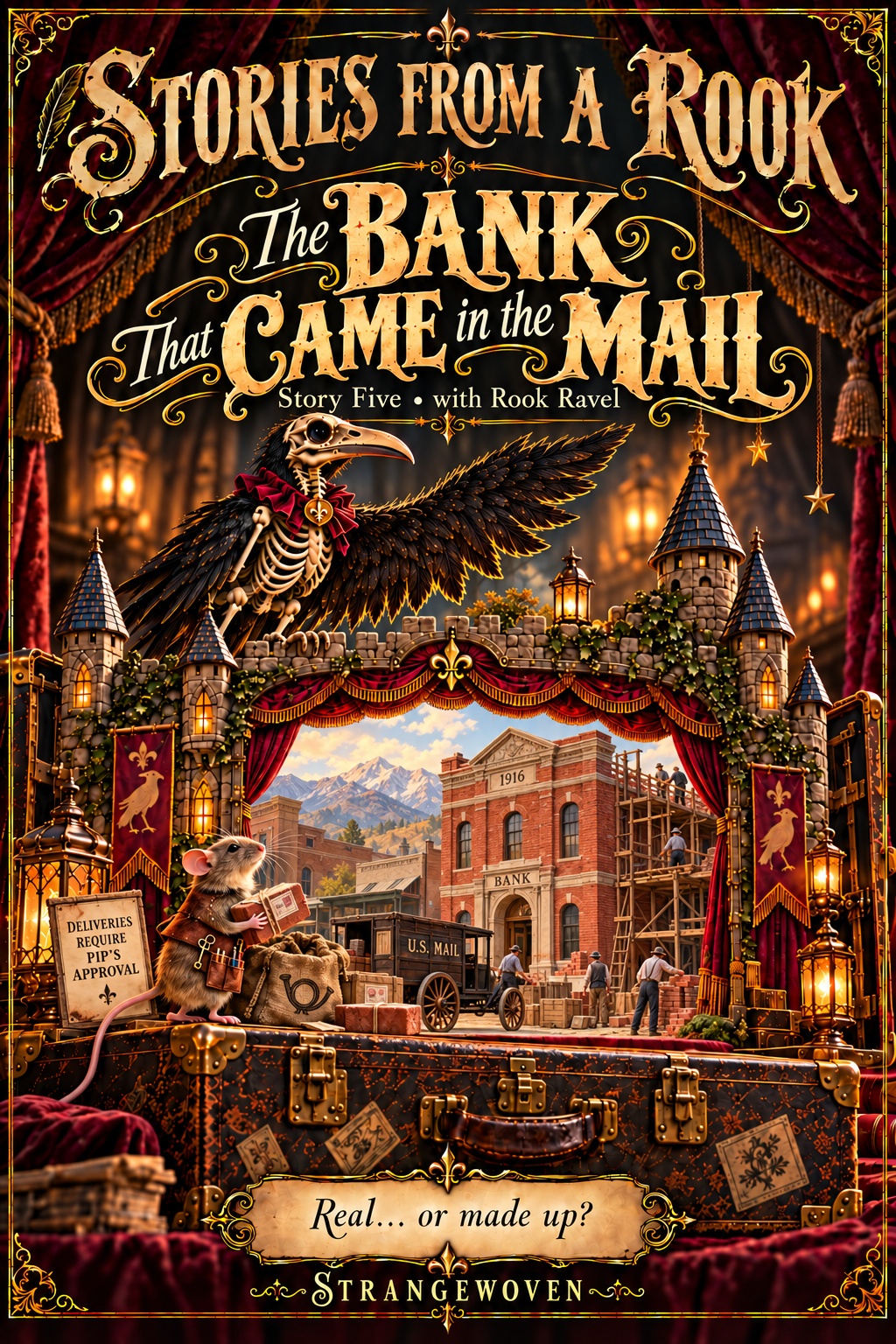
Pip was still sorting the letters from the previous performance when Rook appeared on the battlements.
“No,” said the mouse.
Rook tilted his skull.
“I haven’t said anything.”
“You’re looking at the mail sack.”
“I was admiring your organization.”
“You’ve put something else in it.”
Rook waited.
Pip reached inside.
He brought out a brick.
For a moment, neither spoke.
Then Pip set it on the stage with a firm little thump.
“If this is a love letter, somebody has expressed themselves poorly.”
Rook bowed to the audience.
“I’m going to tell you a story. Is it real or made up? You decide.”
Pip looked into the sack again.
Rook continued.
“This one concerns a bank that came in the mail.”
Pip slowly withdrew his head.
“A bank.”
“Yes.”
“With money in it?”
“Not yet.”
“With a roof?”
“Eventually.”
“Rook.”
“The title requires a little explanation.”
“I should hope so.”
Rook paced the narrow wall above the castle gate. His head lifted. His wings settled neatly behind him.
He became a businessman surveying an empty plot.
“In 1916, in Vernal, Utah, a man named William Horace Coltharp was helping arrange a new building for the town’s bank.”
Pip slid a painted stretch of dusty street behind the towers.
“Most of the building could use local bricks,” Rook said. “But Coltharp wanted particular pressed bricks from Salt Lake City for the outside face.”
Pip stood his brick upright.
“One?”
“Rather more.”
Getting the bricks to Vernal was the problem.
The route was difficult. Transport cost money.
Coltharp wanted a cheaper way.
Rook lowered his head over an imaginary desk. One claw moved across an invisible column of figures.
He counted.
He frowned.
He counted again.
Pip watched.
“That’s how I look when you give me the scenery budget.”
Rook raised a claw.
“Then he considered the post.”
“The post office?”
“The post office.”
Pip looked toward the sack.
“No.”
“Parcel Post could carry packages of up to fifty pounds on that route.”
“No.”
“And the postage cost less than the private shipping rates.”
Pip put both paws on the brick.
“I am beginning to understand why you waited until the audience arrived.”
The bricks were wrapped in paper.
They were packed ten to a wooden crate.
And the crates were sent through the mail.
Rook stepped sideways, becoming a postal clerk.
Pip pushed a little box toward him.
Rook examined it, weighed it with an imaginary scale, and nodded.
Pip brought another.
Rook nodded again.
Pip brought a third.
Rook looked past him.
The mouse had lined up a row of boxes leading behind the castle.
Rook’s voice changed.
“‘How many more?’”
Pip shrugged.
Rook stared down the line.
“‘That is not a number.’”
Pip brought another box.
“About fifteen thousand bricks,” Rook said.
Pip stopped.
“How many crates?”
“About fifteen hundred.”
The mouse sat on the nearest one.
“Someone must have noticed.”
“People noticed.”
“Someone must have complained.”
“There were discussions about unusually large shipments.”
Pip folded his paws.
“I would have contributed.”
“The bricks together weighed more than thirty-seven tons.”
The mouse stood up again.
He inspected the stage beneath his feet.
Then he looked up at Rook.
“How many have you brought?”
“Those are wooden props.”
Pip lifted a box.
It came up easily.
He closed his eyes for a moment.
“Useful information to provide sooner.”
Rook stretched one wing toward the painted street.
“Imagine handling the ordinary mail while all those crates were arriving.”
He became a customer at a counter.
“‘Anything for me?’”
Then the clerk, bending beneath an invisible load.
“‘Bricks?’”
“‘No.’”
“‘Then I shall need a moment.’”
Pip passed him a tiny envelope.
Rook held it aloft with enormous relief.
“‘Correspondence!’”
The mouse applauded once.
“A moving scene.”
“By November, the building’s brickwork was complete,” Rook said. “The bank moved in the following February.”
Pip began stacking the prop boxes into a wall.
“And the post office?”
“That November, postal officials made the rule clearer. More than two hundred pounds of nonperishable merchandise from one sender to one recipient in a day required advance approval.”
Pip added another box.
“So somebody read the rules and found a cheaper way to obtain thousands of bricks?”
“Yes.”
“And somebody else had to carry them?”
“Yes.”
Pip considered that for some time.
“I find that part extremely convincing.”
Rook watched the mouse finish his little wall.
“Have you decided, then?”
“Not entirely.”
“What troubles you?”
“You said a bank came in the mail. Now it’s the facing bricks for a bank.”
“A fair distinction.”
“And you gave me a very precise number of crates.”
“Does that help?”
“It might. Or perhaps you’ve learned that people believe a story more readily when the person telling it has counted something.”
Rook looked toward the audience.
Pip brushed imaginary dust from his waistcoat.
“A thousand five hundred crates sounds much more respectable than ‘an unreasonable number of boxes.’”
Rook bowed to him.
“An excellent point.”
Then he addressed the room.
“Did thousands of bricks travel through the post to help build a bank in Utah? Or have I simply found a heavy way to keep my assistant occupied?”
He spread his wings.
“Real… or made up?”
Pip placed the final box on the wall.
Then he pinned a small notice to the castle gate.
Rook leaned down to read it.
DELIVERIES REQUIRE PIP’S APPROVAL.
“Is that necessary?”
Pip picked up the mail sack.
“Advance approval.”

