Stories from a Rook: The First Ten · Story 4
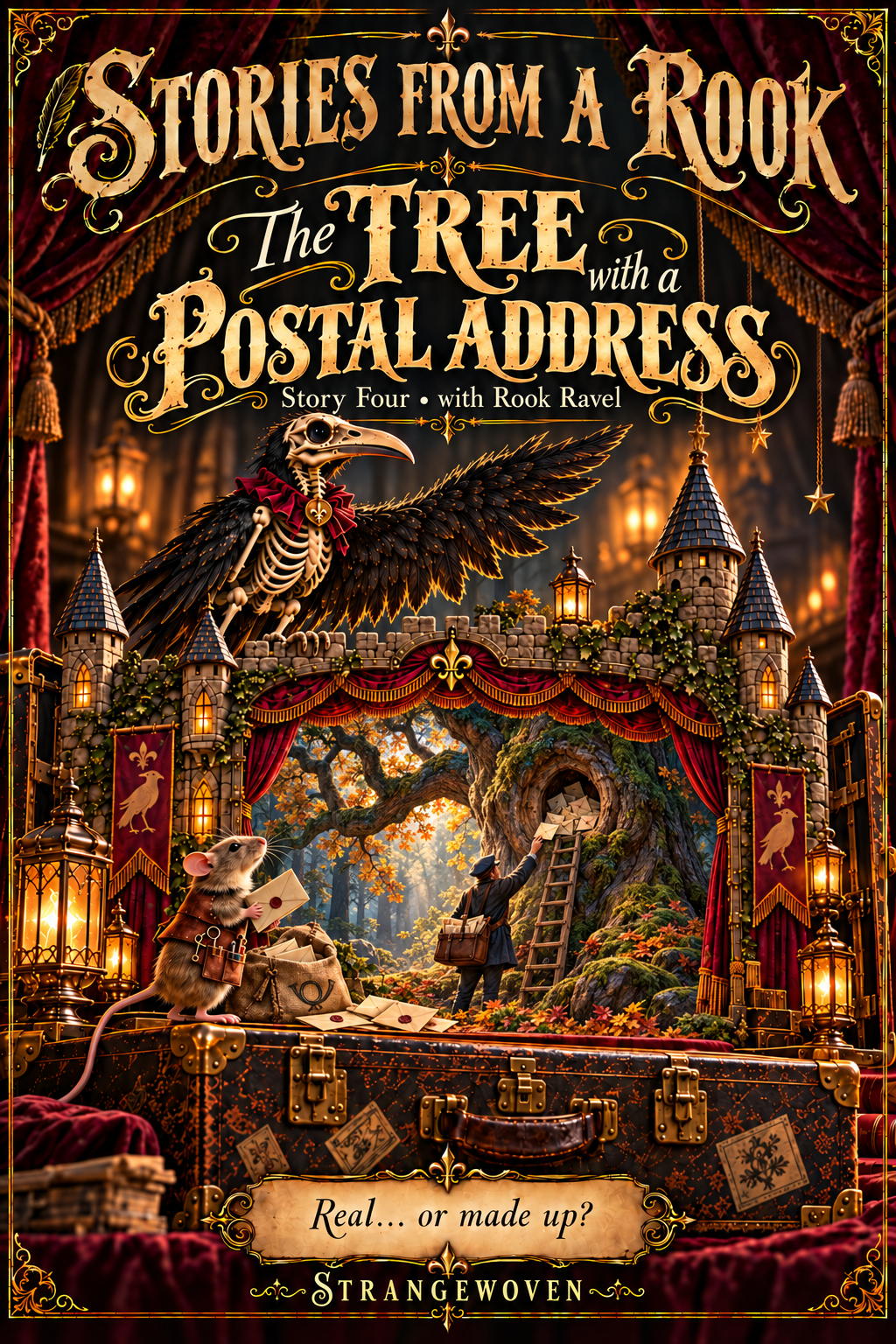
Pip came through the castle gate carrying a sack of letters.
The sack caught on the drawbridge.
He pulled.
The drawbridge lifted.
Rook looked down.
“Expecting a siege?”
“Expecting you to help.”
Rook lifted the sack with his beak. Pip freed the cord, and a shower of tiny envelopes spilled across the stage.
One landed between Rook’s claws.
“To the occupant,” he read.
“That’s a prop.”
“So is the castle. I still occupy it.”
Pip pushed a painted oak tree into the center of the little theater. Its twisted branches reached almost to the battlements. A small ladder leaned against its trunk.
Rook bowed.
“I’m going to tell you a story. Is it real or made up? You decide.”
He rested a claw beside the ladder.
“In a forest in Germany, there stood a tree that received its own mail.”
Pip looked up.
“Someone hung a postbox on it?”
“No.”
“Someone lived inside it?”
“No.”
“An owl?”
“The letters were addressed to the tree.”
Pip glanced at the scattered envelopes.
“That will complicate sorting.”
Rook’s neck lengthened. His chest drew forward. He became a clerk behind a counter, regarding an envelope with deep professional concern.
“‘Name?’”
A small turn, and he was the customer.
“‘An oak.’”
“‘House number?’”
“‘It hasn’t got a house.’”
“‘Street?’”
“‘A forest.’”
Rook turned back into the clerk.
He looked at the imaginary envelope.
Then at the imaginary customer.
Then, with great care, he set the envelope aside.
Pip nodded.
“That part I believe.”
“The tree stood near a town called Eutin,” Rook continued. “There was a hollow in its trunk, high enough that a ladder helped people reach it.”
Pip climbed two rungs of the miniature ladder and tucked an envelope into the wooden hollow.
“The local tale says that long ago, two young people used that hollow to exchange secret letters. Her father objected to their courtship.”
Rook lowered his skull and spoke in a stern parental voice.
“‘I will hear no more of it.’”
Then he became a young man, searching for words.
He opened his beak.
Closed it.
Pip waited.
“Has he forgotten his line?”
“He’s writing a love letter. This may take a while.”
Rook tried again.
“‘Your eyes are like—’”
He stopped.
“Like what?” Pip asked.
“That is the difficulty.”
Pip sat on a ladder rung.
“I hope she’s patient.”
“The tale says the father eventually relented, and the couple married beneath the branches.”
“A happy ending.”
“For them. The tree’s work was just beginning.”
Other people began leaving letters.
People hoping to meet someone.
People who found writing easier than making the first approach.
The custom spread. Letters came from farther away.
“And in 1927,” Rook said, “the oak was given a postal address.”
Pip slowly climbed down.
“By the post office?”
“By the post office.”
“So somebody had to deliver them.”
“Yes.”
“To a hole.”
“Yes.”
“In a tree.”
“You have followed the story admirably.”
Rook stepped onto the narrow wall beside the tower.
His gait changed. He leaned beneath the weight of an imaginary mailbag, picked his way over invisible roots, and stopped before the painted oak.
Pip hurried to move the ladder.
Rook stared upward.
He looked at his imaginary delivery list.
He looked upward again.
Then he sighed with the weary dignity of someone whose workday had become unexpectedly peculiar.
Pip brought him an envelope.
“Does the tree sign for things?”
“I suspect its handwriting would be difficult.”
“Branches everywhere.”
“Quite.”
“But who answered?” Pip asked.
“Visitors could read the letters left in the hollow. If they wished, they could take one and write to its sender.”
Pip turned an envelope over in his paws.
“So the tree didn’t answer.”
“It provided somewhere for the question to wait.”
The mouse looked at the hollow.
“Some letters must have waited a long time.”
“Perhaps.”
“And some might never have been answered.”
“Perhaps.”
Pip carefully put the envelope back.
Rook watched him.
“Not that one?”
“I haven’t read it.”
“Why put it back so gently?”
Pip adjusted the corner so it would not bend.
“Somebody went to the trouble of writing it.”
“There is one more part,” Rook said.
Pip folded his paws.
“There usually is.”
“One of the postmen who delivered letters to the oak was a man named Karl-Heinz Martens.”
Rook settled into the steady stance of someone accustomed to a familiar route.
“He spent years bringing other people’s hopes through the forest.”
Pip reached into the hollow.
“One day, there was a note for him.”
The mouse stopped.
“For the postman?”
“Yes.”
“From whom?”
“A woman named Renate.”
Rook let a little silence gather.
“They met. Later, they married.”
Pip looked from the envelope to the ladder.
Then he looked at Rook.
“You’ve made the ending too tidy.”
“Have I?”
“The postman delivering love letters gets one himself? That’s exactly what somebody telling a story would arrange.”
Rook’s beak tipped toward the audience.
“An excellent objection.”
Pip began collecting the scattered envelopes.
He put them into the sack one at a time.
“The tree has a name?” he asked.
“The Bridegroom’s Oak.”
Pip paused.
“Of course it does.”
“And that is the story,” Rook said. “A forest tree with a postal address, strangers answering strangers, and a postman who found a letter of his own.”
He bowed beneath the castle lanterns.
“Real… or made up?”
Pip shouldered the sack.
This time, he checked the drawbridge first.

