Stories from a Rook: The First Ten · Story 6
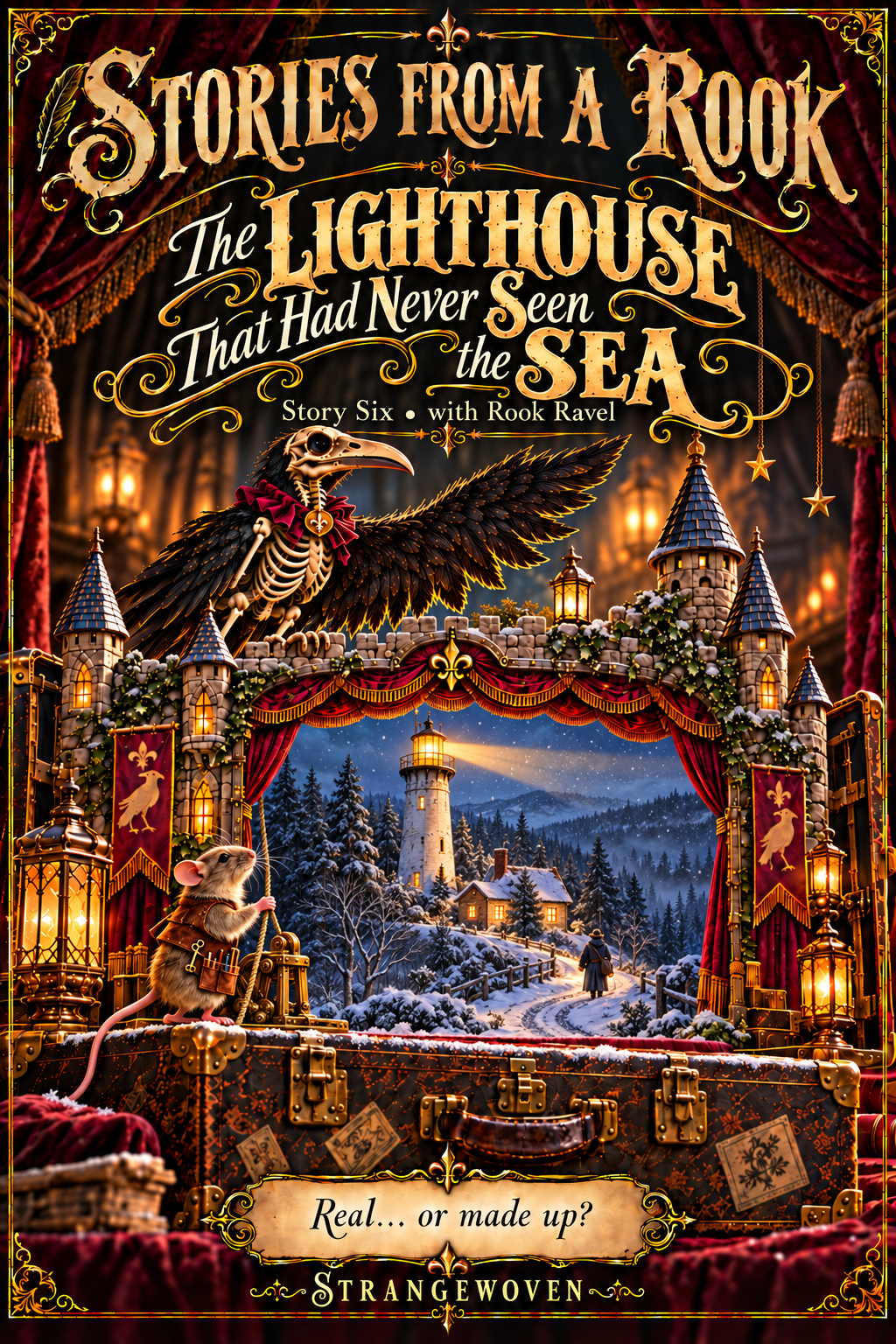
Pip extinguished three lanterns.
Then a fourth.
Rook watched the little theater grow dark.
“Are we saving money?”
“Atmosphere.”
“Ah.”
Pip pulled a painted forest across the back of the stage. Between its black branches stood a narrow white tower.
At the top, a tiny light began to turn.
Rook leaned toward it.
Pip cleared his throat.
“Please don’t touch the mechanism.”
“I was admiring it.”
“That’s what you said about the drawbridge.”
Rook withdrew his beak and bowed.
“I’m going to tell you a story. Is it real or made up? You decide.”
The light swept across his bones.
“There was once a lighthouse that had never seen the sea.”
It stood on a wooded ridge, miles inland.
No harbor lay beneath it.
No ships passed its windows.
From its little gallery, a person could see hills, the tops of trees, and a narrow road winding toward a quarry.
“The man who built it had spent much of his life aboard ships,” Rook said. “When he retired, he bought a cottage beside that road.”
Pip slid a small roof into place.
Rook settled his wings against his ribs. His movements became slow and deliberate.
He was an older man measuring a patch of ground.
“‘A little tower,’” he said.
Pip glanced at the painted lighthouse.
“How little?”
“By the time he finished, the neighbors had opinions.”
Rook became a neighbor, leaning over an invisible fence.
“‘You’re a long way from the coast.’”
A turn of his skull, and he was the sailor.
“‘So are you.’”
The tower rose above the clearing.
The sailor fitted a lamp at the top.
Every evening, he climbed the stairs and lit it.
The neighbors called it his folly.
They gave directions by it, though.
Past the foolish lighthouse.
Turn where the old man built that tower.
If you can see the light, you’ve gone too far.
Pip stopped turning his tiny lamp.
“So it was useful.”
“People can find something useful and still enjoy laughing at it.”
Pip considered the castle’s crooked left turret.
Rook looked away.
Then came a winter storm.
A quarry cart broke an axle on the ridge road.
Two men stayed with the horse. A third went for help.
Snow covered the track. Wind filled his footprints.
He lost the road.
Rook’s posture narrowed. His steps became uncertain. He turned one way, then another.
Pip brushed a handful of white paper flakes across the forest.
The traveler raised an arm against the weather.
For a moment, he could see nothing.
Then a light passed above the trees.
He waited.
It came around again.
“He knew which ridge it stood on,” Rook said. “He could work his way toward the clearing.”
Pip turned the lamp slowly.
The light crossed Rook’s skull.
“The sailor heard him knocking.”
Rook changed at once into the older man, opening a door.
He listened.
Reached for his coat.
“‘Come inside. Tell me where the cart is.’”
The men and the horse were brought off the road.
Afterward, people still called the tower a folly.
They said it rather differently.
The sailor kept its lamp burning.
Years passed.
Then he grew too stiff to climb the stairs each evening.
One autumn, he moved away to live with his daughter.
The cottage stood empty.
The lighthouse went dark.
Pip stopped the turning light.
In the little theater, the forest seemed to draw closer.
“One evening,” Rook said, “the lamp came on again.”
Pip looked up.
“The sailor had returned?”
“No.”
“His daughter?”
“No.”
“A new owner?”
“The cottage was still empty.”
The light burned the following night.
And the next.
There was no ghost floating in the gallery.
There was a person.
A dark figure climbing the stairs near dusk, carrying something beneath one arm.
“If people could see somebody,” Pip asked, “why didn’t they go and ask?”
“One did.”
Rook became a curious neighbor approaching the tower door.
He knocked.
Waited.
Then called upward.
“‘Who’s keeping the light?’”
From above, in a voice flattened by wind, came the answer:
“‘Someone who knows the road.’”
Pip folded his paws.
“That is deliberately unhelpful.”
“It satisfied the neighbor.”
“It wouldn’t satisfy me.”
The neighbor came back the next evening with a loaf of bread.
A woman was climbing the stairs.
The night before, he had been quite certain he had heard a man.
He held up the loaf.
“‘For the keeper.’”
She looked down.
“‘Leave it by the door, please.’”
Two evenings later, a younger fellow was there.
The neighbor stopped him.
“‘How many keepers has this lighthouse got?’”
Rook let the younger man’s voice carry a small, embarrassed laugh.
“‘Depends on who can get away.’”
Pip leaned over the battlements.
“They were taking turns.”
“So the story goes.”
“Who?”
“The two quarrymen. The traveler who had gone for help. Their families. Other people who used the ridge road.”
“Did they have a list?”
“Eventually.”
Pip nodded.
“That makes sense.”
“The first version had three people arriving on Tuesday and nobody assigned to Thursday.”
“That also makes sense.”
Someone supplied oil.
Someone repaired a window.
Someone who could no longer manage the stairs cleaned the lamp glass downstairs.
The tower kept its light.
“Did the old sailor find out?” Pip asked.
“A letter reached him.”
Pip glanced toward the mail sack beneath the stage.
Rook continued before he could object.
“When spring came, his daughter brought him back for a visit.”
The old man stood in the clearing.
The paint had been touched up.
The step by the door no longer wobbled.
Inside hung a slate covered with names and days of the week.
Rook became the sailor again.
For a long moment, he said nothing.
Then he looked toward the top of his tower.
“‘Who’s on tonight?’”
Pip let the little light make another turn.
“I can believe people would do that.”
“Yes.”
“But it’s a very convenient storm.”
“Yes.”
“And a lighthouse in a forest sounds like something you would enjoy inventing.”
Rook glanced around his miniature Gothic castle.
“A reasonable suspicion.”
He faced the audience.
“Was there really an inland lighthouse whose neighbors took over the lamp? Or have I set a light among imaginary trees?”
He bowed.
“Real… or made up?”
Pip began taking down the forest.
He collected the paper snow.
He removed the cottage.
But the little lighthouse kept turning.
Rook looked down.
“Have you forgotten something?”
Pip secured its cord beside the gate.
“The steps down from your tower are rather dark.”

