Stories from a Rook: The First Ten · Story 3
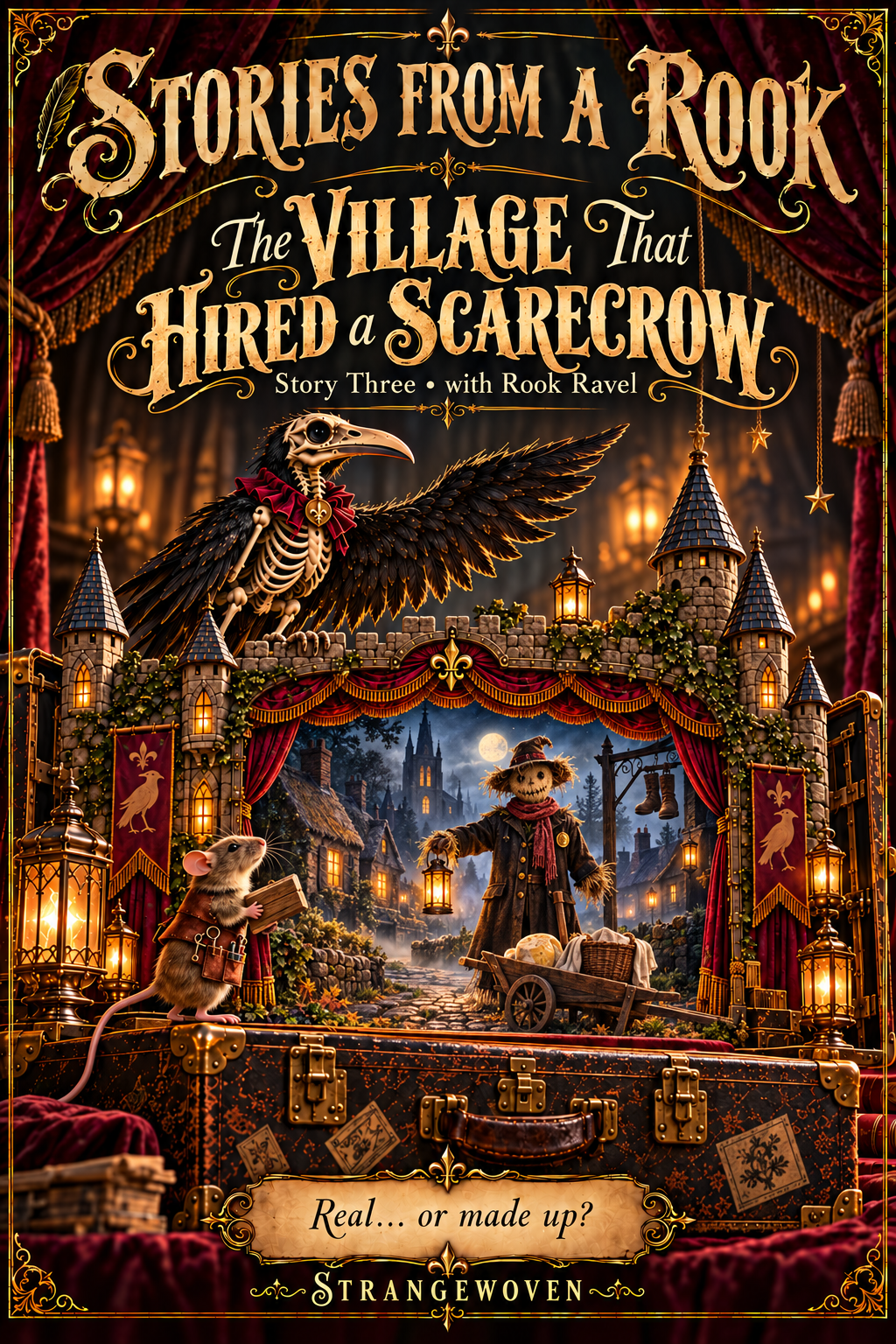
Pip dragged a small wooden figure through the castle gate.
It wore a floppy hat and a coat stuffed with straw. One sleeve had caught on a wheel.
Rook watched from the battlements.
“Our leading gentleman appears distressed.”
“Our leading gentleman is standing on his own coat.”
Pip freed the sleeve and propped the scarecrow beside a tiny painted field.
Rook bowed to the audience.
“I’m going to tell you a story. Is it real or made up? You decide.”
He glanced at the figure.
“This one concerns a village that hired a scarecrow.”
Pip looked up.
“To frighten birds?”
“To keep the peace.”
The village had lost its night watchman to a better-paying position.
His replacement lasted four nights.
The next applicant asked whether the work involved going outside after dark.
Rook tucked his wings behind him, becoming a council chairman of considerable importance.
“‘We require a reliable individual. Someone willing to remain at his post in all weather.’”
Pip glanced at the scarecrow.
“Good qualifications so far.”
“‘Someone who will accept modest wages.’”
“Excellent qualifications.”
“‘And someone who won’t keep interrupting meetings.’”
Pip folded his paws.
Rook continued.
While the council argued, somebody stole two cheeses from the dairy.
The following night, washing disappeared from a line.
Then the chairman’s best wheelbarrow went missing.
“He called an emergency meeting,” Rook said.
“About the cheeses?”
“The wheelbarrow.”
“Of course.”
It was the dairywoman who suggested the scarecrow.
Rook planted his claws wide and spoke in a tired, practical voice.
“‘Put a coat on it. Give it a lantern. Stand it at the crossroads. It might discourage somebody.’”
The council laughed.
The dairywoman waited.
Then she asked whether anyone had a better suggestion.
By dusk, the scarecrow stood beneath the village sign.
It wore the old watchman’s coat. A brass badge had been pinned over its straw-filled chest.
Someone put a wooden truncheon in its sleeve.
Someone else hung a lantern from its arm.
“And did it work?” Pip asked.
“The first night, nothing was stolen.”
“The second?”
“Nothing.”
Pip straightened the little figure’s hat.
“A promising career.”
“On the third morning,” Rook said, “the scarecrow was standing outside the dairy.”
Pip’s paw remained on the hat.
“Who moved it?”
“Nobody admitted moving it.”
“Perhaps the dairywoman.”
“Perhaps.”
A cheese lay at its feet.
One of the stolen cheeses.
The dairywoman said she recognized the cloth.
On the fifth morning, the scarecrow stood beside the washing line.
A basket of missing clothes had been placed beneath its arm.
Pip left the figure alone.
On the seventh morning, the chairman found his wheelbarrow outside his gate.
The scarecrow sat inside it.
Rook lifted his skull and gave the chairman a magnificent, trembling voice.
“‘A thoroughly satisfactory appointment.’”
Pip took a careful step away from the prop.
“The council voted to retain the scarecrow,” Rook said. “The decision was unanimous.”
“What were its wages?”
“One shilling a week.”
“What would a scarecrow do with a shilling?”
“That question also arose at the meeting.”
“And?”
“They decided its personal affairs were its own concern.”
Every Saturday, the clerk placed a shilling in the scarecrow’s coat pocket.
By Sunday, the coin was gone.
Some people said the clerk took it back.
Others said the dairywoman had arranged the whole business.
A few suggested that the village had finally found an honest watchman and ought to stop asking questions.
Rook leaned forward.
“Then a stranger came through.”
He became a broad-shouldered traveler, chin raised, voice loud enough to reach the back row.
“‘You’re all frightened of an old sack.’”
He turned toward the scarecrow.
“‘Come on, then. Arrest me.’”
Pip reached beneath the stage.
Clack.
Rook looked down.
“What was that?”
“The sound effect.”
“Which sound effect?”
Pip consulted a scrap of paper.
“Unsettling wooden noise.”
“Very good.”
Rook returned to his story.
The stranger pulled off the scarecrow’s hat.
Nothing happened.
He shook its wooden hand.
Nothing happened.
Then he took the shilling from its pocket and walked away.
“That seems to settle it,” Pip said.
“The next morning, his boots were hanging from the village sign.”
Pip glanced toward the sign above the miniature gate.
“He had left them outside his room to dry. In their place, he found a small bundle of straw.”
“And the shilling?”
“Back in the scarecrow’s pocket.”
The stranger left before breakfast.
The scarecrow remained in service.
Its coat was mended. Its hat was replaced. In winter, somebody knitted it a scarf.
For several years, the village accounts recorded the same weekly expense:
Night watch: one shilling.
Pip considered the little figure.
“Did anyone ever stay up to watch it?”
“Several people.”
“And?”
“They reported that it stood perfectly still.”
“All night?”
“All night.”
Pip gave a satisfied nod.
“There you are.”
“Although, on one occasion, while three men were watching the scarecrow, someone returned a stolen pig to its owner.”
Pip opened his mouth.
Closed it.
Then picked up his wooden sound block.
Clack.
Rook nodded approvingly.
“So,” the mouse said, “somebody could have been using the scarecrow as a disguise.”
“Certainly.”
“Or several people could have been helping.”
“Certainly.”
“Or the thieves could have become frightened and returned everything themselves.”
“Also possible.”
Pip leaned on the castle wall.
“You make it very difficult to disagree with you.”
“I’ve scarcely disagreed with anyone.”
Rook turned to the audience.
“Did a village truly appoint a scarecrow as its night watchman? Or have I dressed an old sack in a convincing story?”
He bowed.
“Real… or made up?”
Pip began clearing the stage.
He collected the field, the village sign, and the little lantern.
Then he stopped.
“Rook?”
“Yes?”
“Which way was the scarecrow facing?”
Rook looked down.
Pip looked up.
Neither touched it.

