Stories from a Rook: The First Ten · Story 7
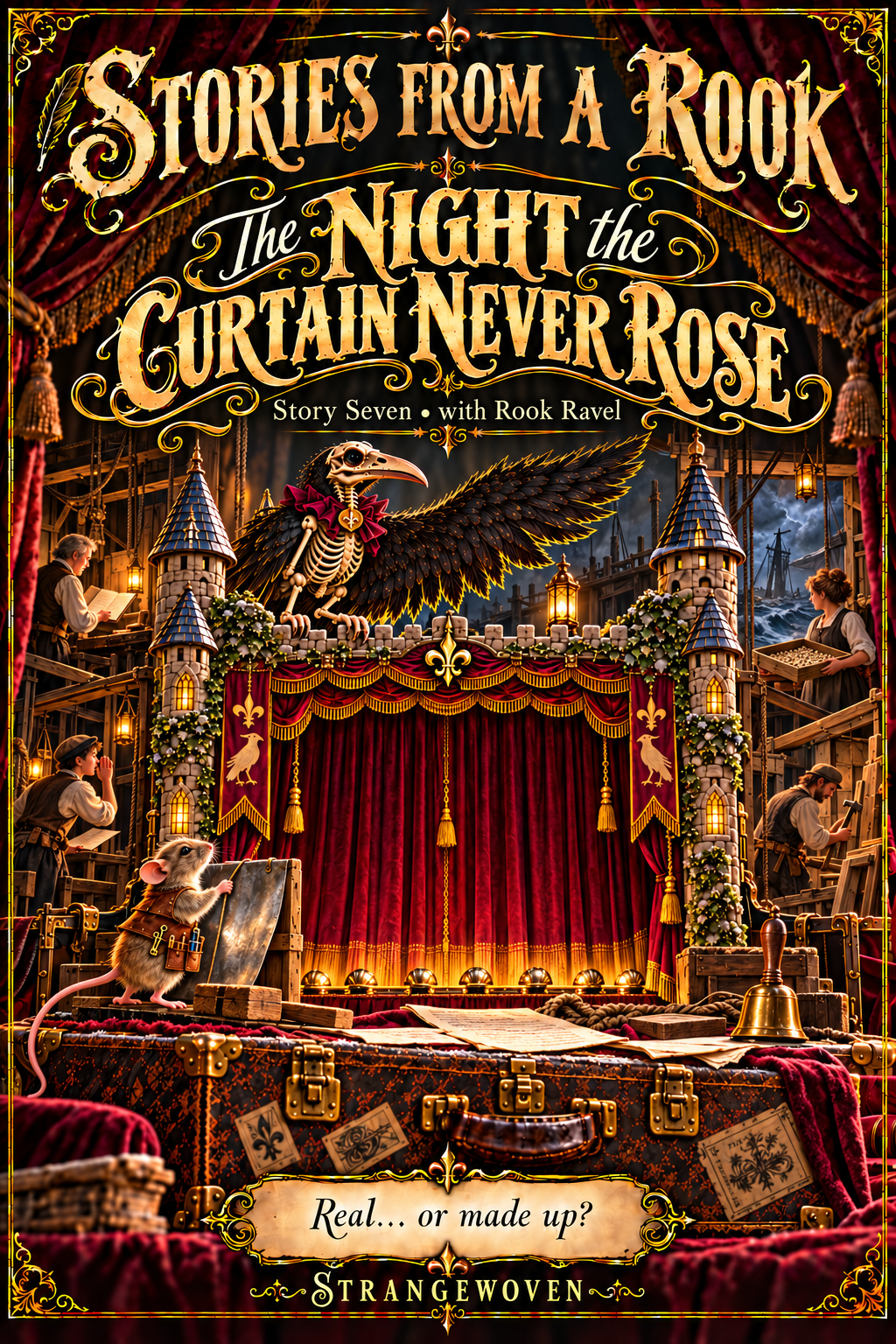
Pip pulled the curtain cord.
Nothing happened.
He pulled harder.
Rook leaned over the battlements.
“Is that part of tonight’s performance?”
“It is becoming part of tonight’s performance.”
Pip disappeared behind a tower. There was a scrape, a mutter, and one small wooden clunk.
The curtains parted.
Pip emerged, carrying a bent hook.
“Ready.”
Rook studied the hook.
“How appropriate.”
The mouse narrowed his eyes.
Rook bowed to the audience.
“I’m going to tell you a story. Is it real or made up? You decide.”
He glanced at the velvet below his claws.
“This concerns an opening night when the curtain never rose.”
The theater had spent nearly everything it could afford.
Its new play had a shipwreck, a missing heir, a captain with a secret, and a splendid painted harbor.
The manager had advertised all four.
Especially the harbor.
Rook became a manager standing beneath a great imaginary poster.
“‘A spectacle of astonishing realism!’”
He turned his head and became the carpenter beside him.
“‘Mind the pier. The paint’s wet.’”
Pip inspected their miniature castle.
“An important distinction.”
On opening night, the company was traveling back from a performance in another town.
Heavy rain flooded the road.
The actors could not get through.
At the theater, the lamps were lit.
The seats were filling.
Behind the curtain waited the manager, the carpenter, the wardrobe woman, and a young fellow employed to make sound effects.
Pip slowly reached for his wooden sound block.
Rook nodded.
“A responsible profession.”
The manager went out before the curtain.
Rook’s wings drew close. He stood very straight, looking over an audience he was afraid to disappoint.
“‘Ladies and gentlemen, there has been a difficulty.’”
He paused.
“‘We ask your patience.’”
The audience waited.
The manager went backstage.
The audience waited longer.
Then somebody stamped a foot.
Somebody else joined in.
Pip tapped the boards.
Tap.
Tap, tap.
Rook glanced down.
“Very convincing.”
“I’ve waited for things.”
The young sound man had been at every rehearsal.
He knew when the ship was supposed to break apart.
He knew when the harbor bell should ring.
He also knew most of the captain’s speeches.
He had heard them through the curtain so often that he sometimes said them under his breath.
The wardrobe woman caught him doing it.
“‘You know the first scene,’” she said.
“‘Everyone knows the first scene.’”
“‘Then start.’”
Rook became the young man, suddenly uncertain.
“‘In front of them?’”
The stamping grew louder.
The manager looked toward the seats.
Then toward the script.
“‘Keep the curtain closed,’” he said.
The lights in the auditorium dimmed.
From behind the curtain came the harbor bell.
Pip struck a tiny piece of brass.
A clear note rang through the little theater.
Then came the wind.
Pip turned a crank.
Rook lowered his body against an imaginary deck.
“‘Reef that sail!’”
He lurched sideways, becoming a frightened sailor.
“‘She won’t answer the helm!’”
A deep roll of thunder followed.
Pip shook a thin metal sheet behind a turret.
Rook stopped.
The mouse peered around the stonework.
“Too much?”
“An excellent storm.”
The carpenter dragged a box across rough boards.
A ship groaned.
The wardrobe woman shook dried peas over a wooden tray.
Rain battered the deck.
The manager read the missing heir’s lines from the script.
The young sound man became the captain.
Then the sailor.
Then a lookout shouting from high above them.
Rook’s head turned sharply. His posture changed with each voice.
“‘Rocks ahead!’”
He planted his claws.
“‘Hold her steady!’”
A crack split the darkness.
Pip snapped two little boards together.
The ship broke.
The audience stopped moving.
Nobody saw the wreck.
They heard boots running across a deck.
They heard timber give way.
They heard a man calling for someone who did not answer.
Then came a long silence.
Pip held perfectly still.
Rook waited.
At last, very softly, the harbor bell sounded again.
A chair creaked in the audience.
Someone took a breath.
Behind the curtain, the wardrobe woman pointed to the next page.
They performed the entire play.
A door became a box lid.
Footsteps through gravel came from a tray.
The wardrobe woman played the innkeeper, then the missing heir’s mother, turning her head away from the audience whenever she needed to change her voice.
The carpenter nearly missed a cue because he was listening.
Once, the manager turned two pages together.
The captain had to ask a question twice.
“‘Where is the letter?’”
A frantic rustle.
“‘I said, where is the letter?’”
Pip glanced at Rook.
“Professional.”
“Necessary.”
At the end, the captain confessed.
The heir came home.
The harbor bell rang one last time.
And the audience applauded.
Behind the curtain, four people looked at one another.
The manager wiped his face.
The carpenter put down a bucket.
The young sound man stared at the velvet.
Then someone in the seats called:
“‘Bring them out!’”
Pip leaned forward.
“What did they do?”
“They opened the curtain.”
“Finally.”
There stood the painted harbor.
There stood the magnificent pier.
And in front of them stood four people surrounded by boxes, trays, a metal sheet, and a script with a torn corner.
The manager bowed.
The wardrobe woman bowed.
The carpenter remembered to remove his apron.
The young sound man tried to hide behind the captain’s empty chair.
The audience applauded again.
Louder.
“Did they perform it that way again?” Pip asked.
“According to the story, they arranged another evening.”
“With the actors?”
“With the four people who had performed it the first time.”
“What did the poster say?”
Rook lifted his skull, becoming the manager once more.
“‘The shipwreck you must hear to believe.’”
Pip nodded slowly.
“That sounds like a theater manager.”
Rook folded his wings.
“An opening night without its company. Four people behind a curtain. An audience that stayed.”
Pip looked at the metal sheet.
“Possible.”
“Certainly.”
“And you would know how the sound effects worked.”
“I spent a great deal of my life in the wings.”
Pip considered him.
“So you could tell it very convincingly either way.”
Rook bowed.
“Precisely.”
He turned toward the audience.
“Did that performance happen? Or have I filled an empty stage with a story?”
The castle lanterns flickered.
“Real… or made up?”
Pip reached for the curtain cord.
Then stopped.
From behind the tower came one small, perfectly timed roll of thunder.
Rook looked down.
Pip bowed.

