Companion for the Grieving Heart · Story Two · A Strangewoven story
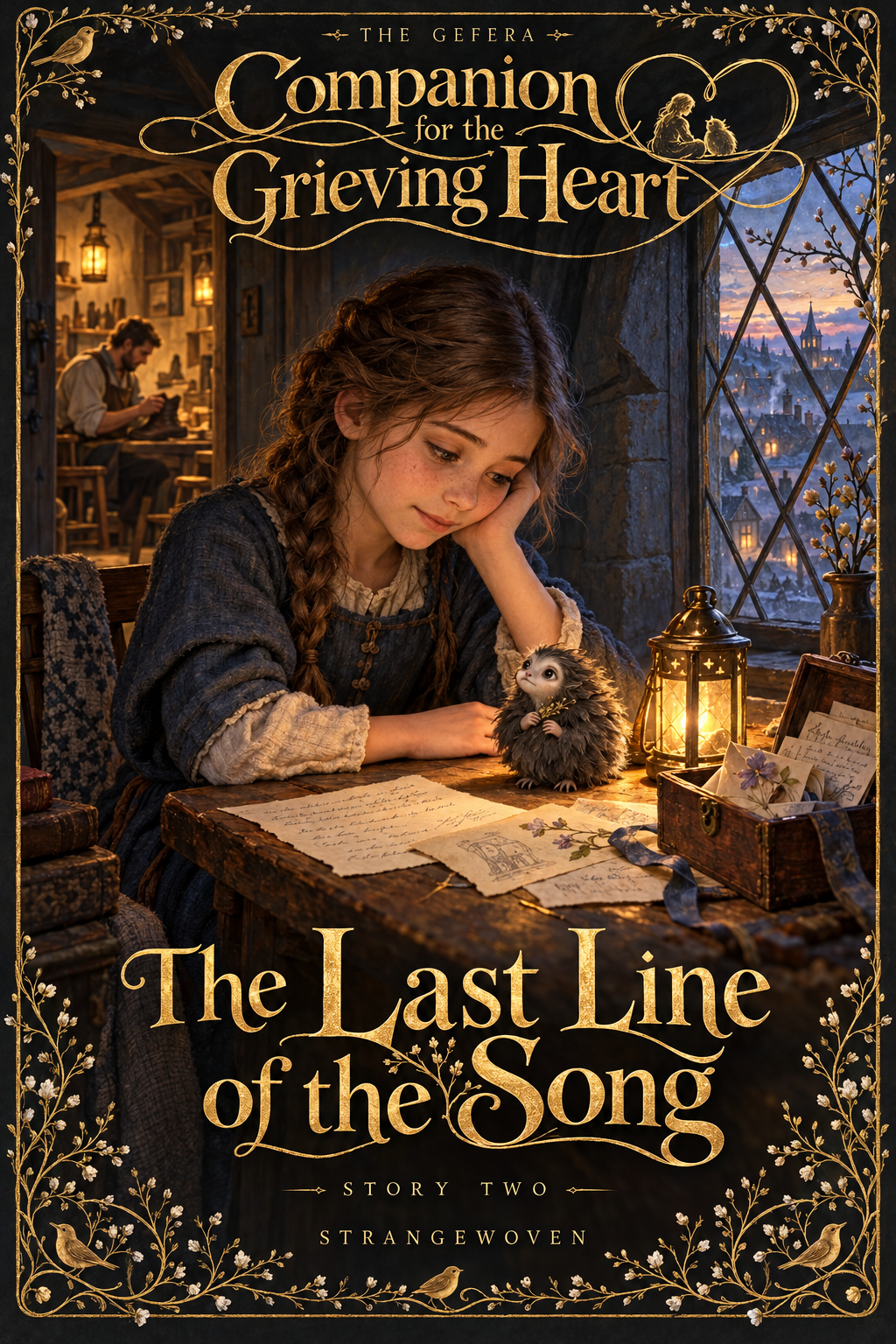
There are houses where grief can be heard from the road.
In others, everyone has learned to move quietly.
My lantern led me to one of those on a morning when frost silvered the roofs. Beneath the house, a cobbler was hammering a new heel onto an old boot. Above him, his daughter sat on the floor with her hands over her ears.
The hammering was not what troubled her.
She was trying to remember a song.
I stood outside her window until the light in my lantern steadied.
Then I knocked against the glass.
Iona knew three things about the creature on her windowsill.
It was too round to be a proper bird.
It had too many feet.
And it was shivering.
She opened the window.
The creature climbed inside with the solemn determination of a person scaling a mountain. It was no larger than a pear, covered in soft charcoal feathers except for its pale face. Four little feet gripped the sill. Two smaller hands emerged from beneath its plumage to catch the curtain before it fell backward.
“You could have used the door,” Iona whispered.
It looked down at the long drop to the street.
“I was nearer the window.”
Iona stared.
The creature shook one foot. A grain of ice fell from it.
“May I come farther in?”
She nodded.
It crossed the floor, climbed onto a folded blanket, and tucked its feet beneath itself. After a moment, it drew out a tiny brass lantern and set it beside the blanket.
“Where were you keeping that?”
“Carefully.”
Iona sat opposite it.
Downstairs, the hammer struck three times and stopped.
“You mustn’t make a noise,” she said. “Father is working.”
“All right.”
“And he doesn’t like animals upstairs.”
“Would you like me to leave?”
She looked at the empty room, then back at the blanket.
“No.”
The creature settled more comfortably.
Its feathers rose until it looked like a small, untidy cloud.
Her father brought breakfast on a wooden tray.
“You missed the bell,” he said.
“I wasn’t hungry.”
“You might be now.”
He set down bread, an apple, and a cup of milk. His sleeve passed so close to the creature that Iona nearly warned him.
He noticed nothing.
The creature watched her without alarm.
“Mistress Pell asked after you,” her father said. “She wondered whether you would come back to lessons this week.”
Iona picked at the crust.
“Perhaps.”
“She said you needn’t join the singing.”
“Then why go?”
He rubbed a dark patch of wax from his thumb.
“There’s writing. And numbers.”
“I can do numbers here.”
“Yes.”
He stood for another moment, searching for something to add.
“I’ll be below,” he said at last.
After he left, Iona closed the door.
“He couldn’t see you.”
“No.”
She considered telling him. She could imagine the effort of explaining the feathers, the hands, the little lantern. But there was no urgency to make him understand. The visitor felt like something she was allowed to keep quietly beside her.
“What should I call you?”
“Gefera.”
“That’s an unusual name.”
“It means companion.”
“Is that your name or your work?”
“It is what I am.”
She gave him a small piece of bread.
He held it in both hands.
For two days, Gefera listened to Iona doing numbers.
She was very good at them. She could divide a bag of flour among six households, calculate the price of nine yards of cloth, and work out how long a cart would take to reach a town she had never visited.
Whenever the lesson-house bell rang, she pressed harder with her chalk.
On the third afternoon, he asked whether she liked singing.
The chalk snapped.
“Not anymore.”
“All right.”
He climbed down from the table.
She watched him wrestle one foot free of a loose thread in the blanket.
“You’re supposed to ask why.”
He looked up.
“Would you like me to?”
Iona put the broken pieces of chalk together. They would not stay.
“Mother sang.”
Gefera waited.
“When she worked. When she went upstairs. She couldn’t carry anything without singing about it. There was one about a bucket with a hole, and one about Father’s awful old shoes.”
From below came the scrape of a chair.
Iona lowered her voice.
“She made that one up.”
“What was it like?”
“It was silly.”
She traced a white line along the crack in her slate.
“I can’t remember all of it.”
Gefera climbed back onto the table. He sat beside her hand.
“There was a song for bedtime, too. About a wren coming home. I knew every word. She only had to start, and I could finish it.”
Her lips moved silently.
“Now I can’t get the last line.”
He said nothing.
“And yesterday I tried to hear her saying my name.”
The chalk crumbled under her thumb.
“I know what she said. I just can’t hear it properly.”
She stared at him, furious suddenly.
“Don’t tell me to try harder.”
“I won’t.”
“Everyone says I have her eyes. Everyone remembers something. But I was there every day, and I can’t even—”
She stopped.
Gefera put one small hand against her wrist.
“You don’t have to finish that sentence.”
She bent over the slate and cried without making a sound.
He stayed until she no longer needed to be quiet.
I could have sung to her.
I have heard more songs than I could count, and I can carry a tune, though there are forms in which this is easier than others.
But she would have listened for her mother in every note.
I had come with my own voice. It would have been unkind to offer it as hers.
That evening, I sat on Iona’s shoulder while she watched her father close the shop.
He checked the latch twice.
Then he took a cup from a high shelf, turned it in his hands, and put it back without using it.
Iona saw him do it.
She went upstairs before he could see her watching.
The following morning, Iona found a scrap of paper and wrote down everything she could remember.
Her mother had a crooked little finger.
She hated pears unless someone else sliced them.
She said that stairs became steeper when there was washing to carry.
She smelled of rosemary in summer.
Iona wrote quickly at first. Then the gaps began to trouble her.
Which hand had the crooked finger?
Was rosemary really her mother’s smell, or was it the soap they all used?
She crossed out a line.
Then another.
Gefera, perched on the rim of her empty cup, shifted his feet.
“What are you doing?”
“Making sure.”
“Of what?”
“That I don’t lose anything else.”
By noon there were four pages. By evening she could scarcely read them for the corrections.
Her father called her to supper.
“In a moment.”
She rewrote the line about the stairs.
He called again.
“I said in a moment!”
Silence followed.
Iona pressed the heel of her hand against her mouth.
Gefera stepped from the cup onto the table.
“The paper will be here after supper.”
“What if I forget something while I’m eating?”
He looked at the crowded pages.
“You are frightened.”
Her shoulders rose.
“Yes.”
“Could you tell your father that much?”
She shook her head.
“He already has enough.”
Below them, a spoon struck the edge of a pot.
Iona listened to him setting the table alone.
After a while, she stood.
She took the pages with her.
Her father had made barley stew.
It was thick enough to hold the spoon upright.
Neither of them mentioned this.
Iona laid the pages beside her bowl.
“Which finger was it?” she asked.
“What?”
“Mother’s crooked one.”
His hand stopped halfway to the bread.
“Her left.”
“Are you sure?”
“She caught it in a gate when she was little.”
Iona reached for her pencil.
“Did she tell you that?”
He nodded.
“She said she was rescuing a kitten.”
“Was she?”
“Your grandmother said she was trying to climb into an orchard where she wasn’t wanted.”
Iona looked up.
Her father was almost smiling.
Then he saw the pages.
“What is all this?”
She tried to explain it carefully. The songs. The missing words. Her mother’s voice growing harder to hear.
“I thought if I wrote everything down—”
He reached across the table.
“Oh, Iona.”
That was all it took.
She pushed back her chair and went to him. He held her with one hand against the back of her head, his other arm around her shoulders.
“I can’t remember how she sounded,” she said into his shirt.
His breath caught.
For a moment she thought she had hurt him exactly as she had feared.
Then he held her closer.
“Some mornings I can’t either.”
She drew back enough to look at him.
There were tears on his face.
“You?”
He nodded.
“And sometimes I remember when I’m not trying. Then I stop everything, and it’s gone again.”
“Why didn’t you tell me?”
He wiped his cheek with the heel of his hand.
“I thought I ought to know what to do before I spoke.”
Iona glanced at the stew.
“You don’t always.”
Her father followed her gaze.
The spoon was still standing.
“No,” he said.
They both laughed a little, with their faces wet.
Gefera sat beneath Iona’s chair while her father fetched more water for the pot.
They did not finish the list that night.
They ate. Her father washed the bowls, and Iona dried them.
Later he brought out a small wooden box from the cupboard.
Inside were letters, a ribbon, and a folded drawing Iona had made when she was six. There was a market tally in her mother’s handwriting and a recipe that began with the words not as much salt as last time.
Her father laid them on the table.
“We could keep your pages here,” he said. “And add things when they come to us.”
Iona touched the recipe.
“What if we remember differently?”
“Then we can write both.”
She thought of the kitten and the orchard.
“Grandmother will want three versions.”
“At least.”
Her father fetched a clean sheet.
At the top, in his slow, square writing, he put her mother’s name.
Elin.
Iona watched him make the last letter.
Then she told him about the wren song.
He remembered the first two lines. She remembered the next three.
They tried singing them together.
Her father was dreadfully flat.
Gefera, unnoticed on the windowsill, closed one eye.
“You may come out,” Iona whispered to him later. “He’s finished.”
“I was listening.”
“With one eye?”
“Very carefully.”
She laughed into her pillow.
Mistress Pell did not ask Iona to sing when she returned to lessons.
She gave her a slate and asked her to help a younger child with subtraction.
At midday, the singing began in the next room.
Iona’s stomach tightened.
Gefera sat inside the fold of her scarf, light as a handful of wool.
“We could go outside,” he said quietly.
“I know.”
She stayed until the second song. Then she put down her slate and asked Mistress Pell if she might walk in the yard.
“Of course.”
No one followed her with advice.
In the yard, she sat on a low wall and listened to the distant voices.
“I don’t want them to stop,” she told Gefera. “I just don’t always want to hear.”
He settled against her neck.
“You can tell them that.”
When she went back inside, she did.
Her grandmother visited at the end of the week.
She brought a pie, a bag of apples, and a firm opinion about the room’s lack of dusting.
When Iona showed her the memory box, she sat down without taking off her coat.
“Your mother couldn’t sing that song properly herself,” she said.
Iona stiffened.
“Yes, she could.”
“Not the way I taught her.”
“It was her song.”
Her grandmother looked at her more carefully.
Then she set the papers down.
“Yes,” she said. “It became hers.”
They were quiet for a moment.
“Will you sing yours?” Iona asked at last.
Her grandmother did.
The tune was familiar, but the words turned in strange directions. There were two extra verses about a field mouse, and the wren came home before the rain instead of afterward.
The ending was wrong.
Iona tried not to cry.
Her grandmother took her hand.
“I wish I had the one you want.”
“So do I.”
“Tell me the bit you have.”
Iona sang three lines.
Her grandmother listened, her thumb moving gently across Iona’s knuckles.
“She made that little turn in the tune,” she said. “I remember now.”
She tried it herself.
It was not Elin’s voice.
But it was someone else remembering her.
Iona moved closer on the bench.
Weeks passed.
The box grew heavier. There were things inside it Iona had never known: a letter written before she was born, a pressed flower from a journey, the orchard story in two different hands.
There were blank sheets, too.
Sometimes she added a sentence. Sometimes she shut the lid and went outside.
Gefera began sleeping on the windowsill instead of beside her pillow.
She noticed, but it did not frighten her.
One afternoon she came home with a new song caught in her head. She was halfway up the stairs before she realized she had been humming it.
She stopped.
From the workshop, her father looked up.
“That’s a good one.”
Iona stood with her hand on the rail.
“It isn’t hers.”
He set down the boot he was stitching.
“No.”
She waited.
“Would you teach it to me?” he asked.
She thought about that.
“You have to listen first.”
“That bad?”
“Very.”
He moved a stool beside his own.
Iona sat down.
She sang softly while he worked.
Upstairs, Gefera’s lantern began to glow.
Iona found him waiting at the open window after supper.
The air smelled of thawing earth.
“Are you going somewhere?”
“Yes.”
She came to stand beside him.
His little lantern lit the worn paint on the sill.
“Another person?”
He nodded.
Iona stroked the feathers between his shoulders.
“We never found the last line.”
“No.”
She looked back at the wooden box on her table. For weeks she had believed there must be some final thing he could give her: the right word, the missing tune, a way to hold a voice exactly as it had been.
He had given her none of those.
But her father knew about the fear now. Her grandmother had promised to write whenever she remembered a story. Mistress Pell knew she might sometimes need the yard.
And there were songs Iona had not learned yet.
“I still want to remember,” she said.
“I know.”
“Even if I can’t.”
Gefera leaned his small weight against her hand.
She stood quietly with him.
The thought of his leaving made her tender, but it did not tear open the place her mother’s death had left. She could feel the difference. This visit was ending, and the things it had helped her begin would still be there in the morning.
“You ought to use the stairs,” she told him.
He glanced at the drop outside.
“That would be sensible.”
She carried him down on her palm.
At the front door, she knelt to set him on the floor. For one brief moment, beneath her fingers, feathers became the coarse cloth of a traveler’s mantle.
Then he was looking up at her again, round and solemn.
“Goodbye, Gefera.”
“Goodbye, Iona.”
She opened the door.
The little light went down the lane.
That night, her father knocked before coming into her room.
“Would you like company?”
Iona moved over on the bed.
He sat beside her, tired hands resting on his knees.
For a while, they watched the moon through the window.
“The wren song?” he asked.
She nodded.
They sang what they remembered. In places they disagreed, and in one place her father forgot the words entirely.
When they reached the missing line, Iona felt the familiar ache.
Her father stayed beside her.
“Again?” he asked after a while.
“Not tonight.”
“All right.”
She rested her head against his arm.
“Tell me about the orchard instead.”
Her father smiled.
“Well. Your grandmother says there was no kitten.”
“But Mother said there was.”
“Your mother was very definite about the kitten.”
Iona closed her eyes to listen.
At the turning of the lane, I heard a little singing.
It was not the song she had been trying to remember.
Her father had started the new one, and Iona was correcting him.
I paused beneath the bare branches.
Then I put my lantern safely beside the road, climbed onto a low stone, and shook the frost from four small feet.
Far away, another light shone in a window.
I stepped down from the stone in my old boots, drew my mantle around me, and went on.
