Companion for the Grieving Heart · Story One · A Strangewoven story
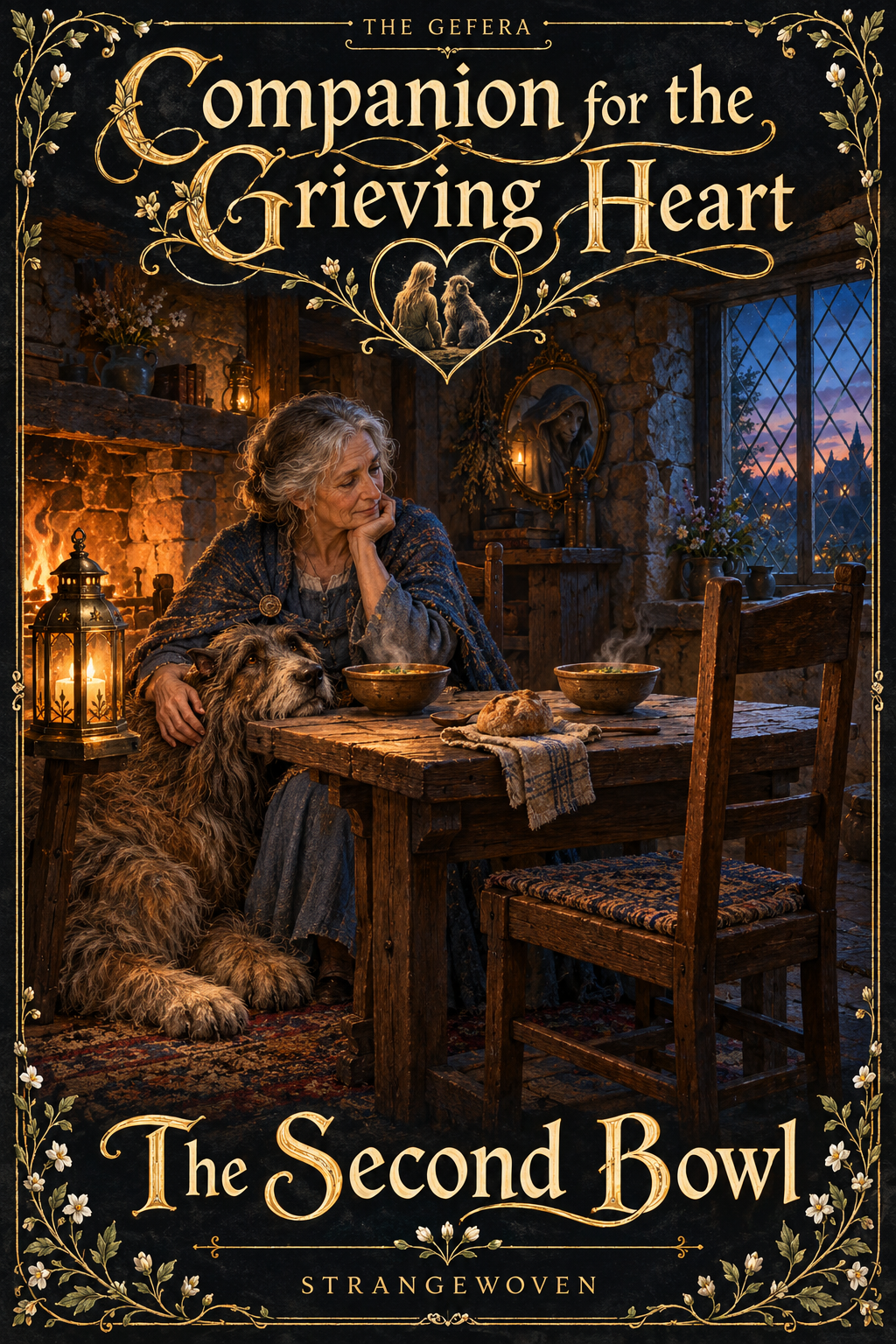
My lantern began to glow while I was mending a pocket.
There was no flame inside it. There had never been a flame, though I had been asked about that often enough. Light gathered behind the glass like morning finding its way through a curtain.
I put down my needle.
The pocket could wait.
Beyond my door, a narrow road lay beneath the stars. Tonight it led downhill, toward a village with a crooked bridge and a mill that had stopped turning for the winter.
In the last cottage before the woods, a woman was setting out two bowls.
She noticed what she had done when she reached for the second spoon.
I felt the lantern grow warm in my hand.
Then I went to her.
Mara stood beside the table until the soup stopped steaming.
She could put the other bowl away. It was a simple thing. Lift it, turn, open the cupboard.
Instead she sat down.
Across from her, the empty chair stood at its usual slight angle. Tomas had always pushed it back with one foot when he rose. She used to straighten it and tell him that one day he would catch his heel and crack his head.
Thirty-seven years of warning him about the chair.
And then a fever.
The latch lifted.
Mara looked toward the door.
A creature stood on the threshold, broad enough to block the draft. Long, untidy fur hung around its face. Its ears folded at the tips, and its eyes had the patient expression of someone prepared to wait while she remembered what words were for.
One large paw rested inside the cottage.
The other remained outside.
“Well,” Mara said at last. “You cannot stand there all night.”
The creature came in.
It closed the door carefully behind itself.
That should have surprised her more than it did.
It crossed to the hearth, turned twice on a rug too small for it, and lowered itself with a sigh.
“That was his rug,” she said.
The creature began to rise.
“No. You can stay.”
It settled again.
Mara looked back at the bowls.
After a while, she ate from one.
In the morning, the creature was still there.
Mara found this neither alarming nor especially remarkable. What troubled her was the thought of fetching wood. The pile beside the hearth had dwindled to three crooked pieces, and fetching more meant putting on Tomas’s old coat, because hers had a torn lining she had not repaired.
His coat hung beside the door.
She had not touched it in nineteen days.
The creature watched her from beneath a fringe of fur.
“You might make yourself useful,” she told it.
It looked toward the wood basket.
“I meant you could fetch some.”
“I could walk with you.”
Mara sat down abruptly.
The creature waited.
“You speak.”
“Yes.”
“You might have mentioned it.”
“You were eating.”
She studied its face. Its voice did not resemble Tomas’s, or anyone else’s she knew. It was low and unhurried, with room around the words.
“What are you?”
“A companion.”
“Whose?”
“Yours, if you wish.”
Outside, water dripped from the eaves.
“Do you have a name?”
“You may call me Gefera.”
“Is that your name?”
“It is what I am.”
Mara rubbed her hands against her knees.
“Well, Gefera. I still need wood.”
“Yes.”
She took the coat from its peg.
For a moment she held it without moving. There was a small hard lump in one pocket. A wooden button Tomas had meant to sew back onto his sleeve.
She closed her fingers around it.
Gefera stayed beside her until she could put the coat on.
Nell from the bakery came that afternoon carrying a loaf beneath a cloth.
She found Mara seated by the hearth, one hand buried in shaggy fur.
“There you are,” Nell said. “I knocked yesterday.”
“I heard.”
“Ah.”
Nell put the bread on the table. Her gaze passed over the rug without stopping.
Mara looked from her visitor to Gefera.
Somehow she understood. Nell saw the hearth, the rug, the chair. The companion was hers to perceive.
There was no sudden need to point him out. No sense of having discovered a marvel that must be proved. She could speak of him if she wanted, but just then she wanted to smell fresh bread.
“Would you stay for a slice?” she asked.
Nell paused with her hands still on the cloth.
“I would.”
They ate at the table.
Nell talked about the miller’s youngest boy, who had tried to mend a wheelbarrow and built something that could only turn left. Mara listened. Once, almost without noticing, she asked a question.
When Nell left, half the loaf remained.
Mara returned to the hearth.
“She cannot see you.”
“No.”
“Does that happen often?”
“Every time.”
Mara considered this.
“It must make introductions difficult.”
One folded ear lifted.
For the first time in nineteen days, the corner of her mouth moved.
I do not always come clothed in fur.
There have been doorways where a traveler was welcome, and bedsides where only a small creature could approach without being asked to leave. Once, for a boy who would not speak, I came with feathers and spent three days learning how to sit on a fence.
I was not very good at it.
Mara had no patience left for visitors who needed tea, explanations, or reassurance. A large quiet creature could lie beside her without requiring any of those things.
So that was how she saw me.
On the fourth night, she told me about the fever.
I listened.
On the fifth, she told me again.
I listened then, too.
“I should have gone for the healer sooner.”
Mara sat on the floor beside the rug. Her back hurt, but she did not want the chair.
“You fetched her when he worsened,” Gefera said.
“I could have fetched her before.”
He did not answer immediately.
“Would it have mattered?” she demanded.
“I do not know.”
She turned toward him. “Then what good are you?”
The room became very quiet.
Gefera remained where he was.
Mara waited for an offended reply, or a gentle correction that would make her feel worse. Neither came.
At last she pressed her fists to her eyes.
“I am sorry.”
“You may be angry here.”
“I am angry everywhere.”
Her voice broke on the last word.
“He asked for water. That is what I keep remembering. Such a little thing. He asked me for water, and I thought there would be a hundred more things to fetch him.”
She bent forward.
Gefera moved close enough for her to lean against him. He did not tell her that Tomas would want her to be happy. He did not ask her to count her blessings.
When she could speak again, she asked the question she had been keeping beneath all the others.
“Do you know where he is?”
Gefera lowered his head.
“I have no message from him, Mara.”
She gripped his fur.
“I wanted one.”
“I know.”
The fire settled in the hearth.
He stayed with her until she slept.
There were things she could do and things she could not.
She could wash a bowl. She could not wash his cup.
She could open the shutters in the kitchen. She could not open the chest at the foot of their bed.
Gefera appeared to keep no account of either list.
When she swept, he lifted his paws. When she cried, he stayed. Once, while she was trying to mend a stocking, his fur caught around her needle and she accused him of being the least practical creature ever assembled.
“I have been told that before,” he said.
She pulled out a long strand of hair.
“I believe it.”
The laugh surprised her. It escaped before she could stop it.
Then she went still.
Her eyes moved to the empty chair.
Gefera waited as the laughter drained from her face.
“That felt wrong,” she whispered.
“What did?”
“For a moment I forgot.”
“And now?”
“Now I remember.”
He rested his head beside her knee.
She looked down at the ruined stitch. After a while, she pulled it loose and began again.
The first time Mara went to the bakery, she returned without going inside.
Too many people were standing at the counter. Through the window she had seen a man touch his wife’s shoulder as he moved behind her, an ordinary gesture so familiar that Mara could almost feel Tomas’s hand.
She walked home quickly.
Gefera kept pace.
“Do not tell me to try again tomorrow,” she said.
“All right.”
They did not go the next day.
On the day after that, Nell arrived with flour on her cheek and asked if Mara would help sort a box of buttons after closing.
“My mother’s,” she explained. “She saved every button that ever passed through her hands. I think some of them predate clothing.”
Mara almost refused.
Then her fingers found the button in Tomas’s coat pocket.
“After closing?”
“Just us.”
Gefera lay beneath the bakery table while the women worked.
There were hundreds of buttons: horn, wood, brass, bone. Nell insisted on sorting them by size. Mara preferred the number of holes. They argued gently over one large button that had no holes at all.
“That is a pebble,” Mara said.
Nell examined it.
“So it is.”
They laughed.
This time, when the sadness followed, Mara did not get up to leave.
She held Tomas’s button in her palm.
“He was forever losing these.”
Nell looked at it, then at her.
“Tell me.”
So Mara did.
The thaw came slowly.
Water ran beside the road. The mill wheel moved one morning, stopped, then moved again after three men spent an afternoon shouting advice at it.
Mara began helping Nell twice a week. Some mornings she woke and wanted to go. Some mornings she went because she had promised. Once she sent word that she could not manage it, and Nell sent back a small loaf without a question.
Gefera accompanied her less often.
At first he waited by the bakery door. Later he remained at the cottage, stretched before the hearth.
One afternoon Mara came home carrying a little packet of seed.
“Nell thinks I ought to plant something.”
Gefera opened one eye.
“What do you think?”
“I think she had too many seeds.”
She set the packet on the windowsill.
The following day, she found a pot.
Then came a morning when everything hurt again.
It was the smell of cut wood. Someone nearby was repairing a fence, and the fresh shavings brought Tomas into the room so vividly that Mara turned to speak to him.
The space beside her was empty.
She sat on the bed and could not finish dressing.
Gefera found her with one shoe in her hands.
“I thought I was doing better,” she said.
He settled against the bed.
“You have been.”
“Then why am I here?”
“You miss him very much today.”
She stared at the shoe.
“Yes.”
They sat until the hammering outside stopped.
By noon she had put on both shoes. She ate bread standing at the kitchen table, and later she went to Nell’s back door.
“I cannot sort anything,” she said when Nell opened it. “And I do not want to be cheerful.”
Nell stepped aside.
“The kettle is on.”
Gefera waited outside in the pale afternoon sun.
I knew my leaving was near when Mara began bringing her sorrows to other doors.
There was no single morning when she became well. I would not have known how to measure such a thing.
But she had asked Nell to walk with her to the graveyard. She had let the miller mend the loose shutter. She had told a story about Tomas without apologizing when she cried halfway through it.
And one evening, finding a tear in his old coat, she brought me the needle.
“Hold still,” she said.
She could not have explained why my mantle was suddenly beneath her hands, or why her needle passed through worn cloth instead of fur. It troubled her no more than the way a dream can contain two true things at once.
She repaired the pocket I had left unfinished.
Her stitches were small and firm.
“There,” she said. “You ought to let someone look after you occasionally.”
I thanked her.
The last evening was ordinary enough that Mara nearly missed it.
She made soup. Rain tapped against the window. Gefera sat nearer the door than the fire.
Mara reached into the cupboard and took down one bowl.
Then she paused, took down another, and set it beside the first.
“Nell is coming,” she explained.
“I know.”
Something in his voice made her turn.
For the first time she saw the lantern clearly. It stood beside him, its brass worn smooth around the handle. A little light was gathering behind the glass.
Mara set down the spoon.
“Someone else?”
“Yes.”
She looked at the rug, with its flattened patch where he had lain. She would remember that shape. She would remember the folded ears and the patient eyes.
But the old terror did not rise. No sickening drop, no feeling of a door shutting before she could reach it.
She was sad to see him go. Beneath the sadness lay a steadiness she had not expected.
“I shall still have bad days,” she said.
“Yes.”
“I may have a very bad one tomorrow.”
“You may.”
She considered the two bowls. Nell would knock soon. There was bread beneath the cloth, and the small green shoots on the windowsill needed turning toward the light.
“What happens if I forget your face?”
Gefera came to her.
“Then remember sitting together.”
Mara put her arms around him. For a moment there was fur beneath her cheek, and beneath her hands the rough weave of an old mantle.
“Thank you,” she said.
He inclined his head.
She opened the door for him.
At the garden gate he looked back. Mara stood in the warm doorway, one hand holding Tomas’s coat closed at her throat.
She raised the other.
Then a familiar voice called from the road.
“I have brought too much bread again.”
Mara turned toward Nell.
“You always do.”
When she glanced back, the gate stood empty.
She watched the road for a little while, smiling through tears. Then she went inside with her friend.
Much later, Mara washed both bowls.
She left Tomas’s cup on its shelf. She might leave it there all her life.
In the morning, she intended to ask Nell whether the bench outside the bakery needed painting. Tomas had always mixed too much paint, and there were jars in the shed that might still be good.
She banked the fire and straightened the empty chair.
Then, remembering, she set it back at its familiar slight angle.
“Good night, love,” she said.
She went to bed.
Rain found me beyond the bridge.
I put one hand into my newly mended pocket. Mara had left something inside: the long strand of fur she had pulled from her stocking, wound carefully around a scrap of card.
I carried it with me.
Farther down the road, my lantern brightened.
In a house I had not yet seen, someone sat awake, listening for footsteps that would not come.
I drew my mantle close and followed the light.

