Story One · A Strangewoven story · Five chapters
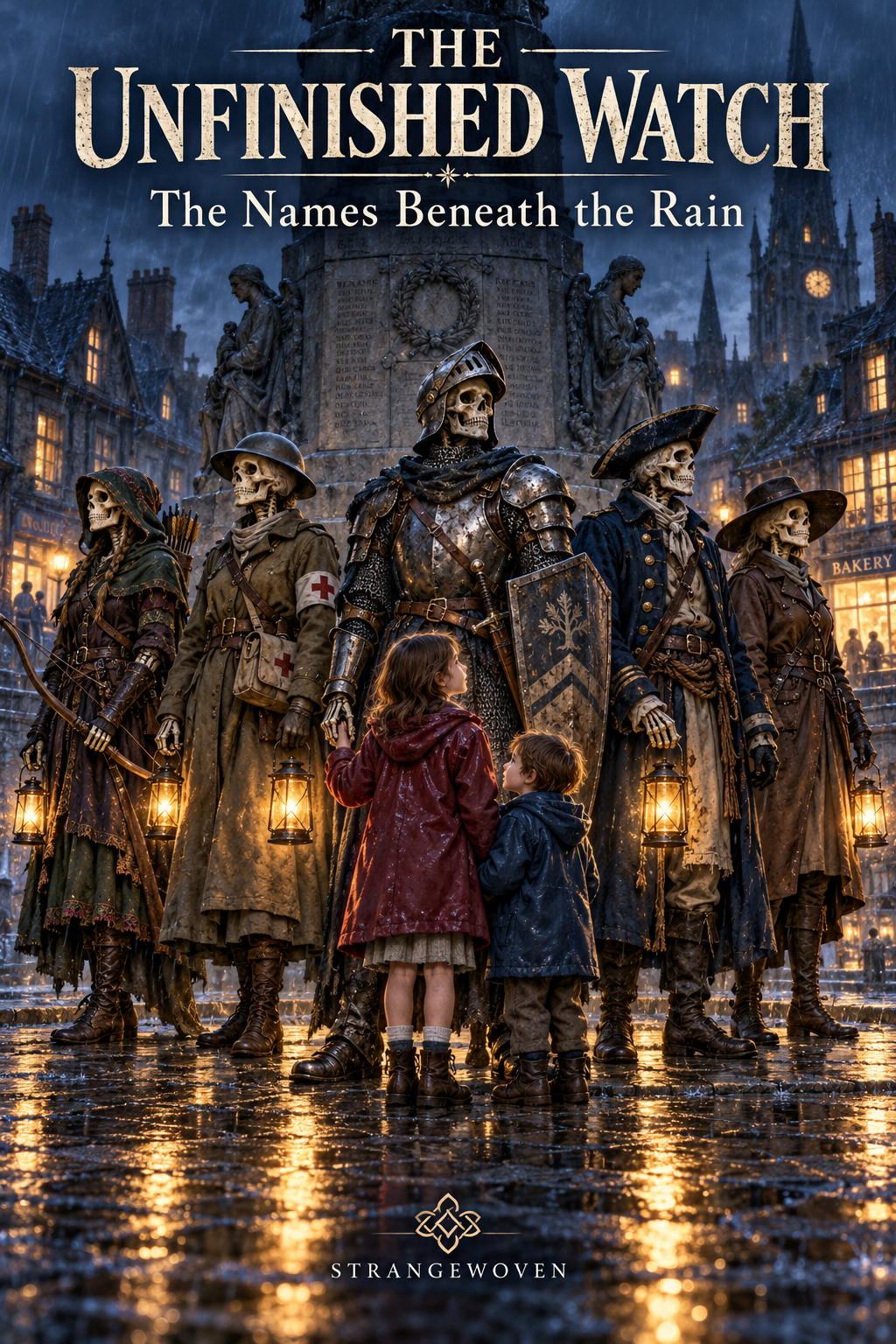
Chapter One: A Letter for the Dead
Nell Mercer chose the dead because everyone said they had been brave.
She did not know whether brave people stayed brave after dying. She hoped so.
Rain ran down the soldiers carved into Bellweather’s war memorial. One carried a shield, another a long musket, another a stretcher. Below them, rows of names filled the stone. Nell had copied three before her pencil snapped. There were too many to address them properly.
Instead, she wrote:
To anyone who can help.
She crouched beneath the stone stretcher, shielding the paper with her coat.
My name is Nell Mercer. I am eleven. My brother is Kit. He is six. Our mum did not fall in the river.
She stopped. Across the square, the library clock showed fourteen minutes past five.
Her uncle would be back at the house by half past.
I heard Uncle Daniel tell her he needed the red book. Then I heard her tell him to get out. The next day he said she had an accident. Yesterday I found her blue button in his car. He saw me find it.
Water fell from her sleeve onto the word mum.
He says we are going away tonight. I tried to talk to someone at school, but he came early. I don’t know where he is taking us. Please come to the yellow house by the bakery. Kit thinks I can fix things.
There was room for one more sentence.
Please be real.
She folded the page, pushed it into a crack beneath the names, and ran.
For nearly an hour, nothing happened.
Water gathered in the stone soldiers’ eyes. A bus sighed at the curb. Someone hurried past carrying bread beneath a coat.
Then the letter disappeared into the memorial.
Deep beneath the square, something struck iron once.
Oswin woke remembering a gate.
He had held it with his shoulder while people fled through the opening behind him. He remembered the weight of the timber, the terrible heat, a woman struggling with a basket that contained a sleeping baby.
He did not remember letting go.
Now he knelt on wet paving with an iron lantern in his hand.
His fingers were bare bone.
He looked at them for some time.
“Well,” someone said nearby. “That will complicate the bandaging.”
A woman in a mud-stiffened military coat sat beside the memorial. A canvas medical bag lay across her knees. Beneath her dented steel helmet, her face was a skull.
Oswin touched his own face.
“Yes,” she said gently. “You too.”
A tall skeleton in a sailor’s coat was examining a row of electric streetlights. Another, wearing a weathered riding coat, had climbed halfway up the memorial to study the roads. Beside the carved shield stood an archer in patched wool and leather.
Oswin knew the fastening at her shoulder.
“You wore the stag,” he said.
Her hand went to the faded badge.
“And you wore the tower.”
He remembered arrows striking his gate.
She remembered something too. He saw it in the way she moved her hand toward her bow.
Then each lantern brightened.
A child’s voice spoke from inside the glass.
Kit thinks I can fix things.
The archer’s hand fell.
Oswin rose. Rust shifted inside his armor.
“Where?” he asked.
Five pale lights leaned toward the same street.
Chapter Two: The Yellow House
The house beside the bakery stood dark.
Its front door was locked. A small shoe lay overturned behind the glass.
The woman in the riding coat crouched beside the drive.
“Car left recently. Someone dropped a bag here.” She pointed to a scatter of damp clothes near the hedge. “They were hurried.”
“Ada Rusk,” she added, looking up. “If we’re going to work together, names might help.”
“Miriam Shaw,” said the medic.
“Tomás Vela.” The sailor lifted his lantern.
“Ysabet,” said the archer.
Oswin gave his name last. Neither he nor Ysabet offered a hand.
Miriam tried the door, then looked through the narrow window beside it.
“A telephone on the table. We need someone living.”
“We need the children,” Oswin said.
“Both.”
He looked at her.
“I spent a war watching men confuse urgency with doing everything themselves,” she said. “It rarely improved matters.”
Across the street, a woman stood beneath a bakery awning, staring at them through the rain.
Tomás raised an empty hand.
The woman dropped her keys.
“We shall need to work on introductions,” he murmured.
Miriam crossed slowly, keeping her hands visible.
“The Mercer children,” she said. “Do you know where they’ve gone?”
The woman backed into the bakery door.
“Please,” Miriam said. “We are looking for Nell and Kit.”
At the names, the woman stopped.
“Daniel took them. Said they were staying with relatives.”
“Did they seem willing?”
The baker looked toward the yellow house.
“Little boy was crying. Nell kept looking at me.” Her voice thinned. “I thought it was because of their mother.”
“You couldn’t know,” Miriam said. “You can help now. Call the police. Tell them the children may be in danger. Tell them to check Daniel Mercer’s car.”
The baker fumbled a telephone from her pocket.
Ada had come across the road. “What does he drive?”
The woman described a gray estate car, then gave its registration from memory.
“He parks across my delivery entrance often enough.”
She dialed. When the operator answered, she turned sideways, watching the five figures as if they might disappear before she could explain them.
Nell’s lantern whispered again.
This time it was not the letter.
Don’t cry, Kit. Here. You can have my sleeve.
A rapid knocking followed. Metal against metal.
Then the sound faded.
Oswin gripped the lantern’s handle.
“Can you hear us?” he asked it.
Nothing answered.
“It brings the call,” Miriam said. “Perhaps it cannot carry ours back.”
Ysabet stood watching the bakery window. On its lower shelf sat a plate of small iced cakes.
For a moment the square was gone. She remembered taking a loaf from a ruined kitchen, then finding two children underneath the table. They had watched her eat.
She had put the bread down between them.
Later, when her own soldiers came to clear the street, she had stood in the kitchen doorway.
She remembered what had happened next.
“I was not at your gate when I died,” she told Oswin.
He looked at her, but she had turned away.
The five lanterns pulled toward the river.
Behind them, the baker was speaking quickly.
“No, I’m quite certain I said skeletons. But please listen about the children first.”
Nell sat on a folded tarpaulin in a locked storeroom.
Kit leaned against her. He had cried until he became quiet, which was worse.
“We’re not staying,” she whispered.
“How do you know?”
She had no answer for that.
Outside, Uncle Daniel dragged something heavy over the floor. He had stopped using his reassuring voice after Nell saw the blue button.
Their mother’s coat had lost that button two weeks before she died. Nell had promised to sew it back on. There had been so many ordinary chances to do it.
Now she could think of nothing else when she closed her eyes.
Kit tugged her sleeve.
“Is he angry because of the book?”
Nell stared at him.
“What book?”
“Mum’s red one. The one she put in the clock.”
Footsteps stopped outside the door.
Nell drew her brother close.
“What did he say?” Daniel asked.
Chapter Three: What the River Kept
The lanterns led the warriors to an old riverside warehouse.
Tomás knew the shape of it before he saw the faded lettering: loading doors, an upper hoist, timbers built to bear weight. The river slapped its pilings beneath the floor.
He had died on a ship that carried families out of a burning harbor. The last thing he remembered was lowering a boat. Someone had cut the rope too soon.
He paused with his hand against the warehouse wall.
“Tomás?” Miriam asked.
“I know this noise.”
Inside came a man’s raised voice.
“You should have told me that before.”
Oswin went for the nearest door.
Ysabet caught his arm.
Through a split in the boards, they could see Daniel Mercer kneeling in front of a little boy. Nell stood between them, both hands spread against her uncle’s chest.
“You frighten him,” Ysabet whispered to Oswin, “and he has them within reach.”
Oswin stayed still. Every part of him remembered the gate, the need to hold, the belief that strength applied quickly enough could settle anything.
Miriam leaned close to the crack.
“Nell,” she said softly.
The girl looked up.
“Don’t look this way again. Help is here.”
Daniel stood and pulled his telephone from his pocket.
“We’re going back to the house,” he said. “And you two will behave.”
He moved toward the far side of the room to make a call.
Ada circled toward a smaller door. Ysabet followed, moving without a sound. Tomás studied the service entrance’s old latch.
“This,” he whispered, “I understand.”
Miriam stayed where Nell could hear her.
“In a moment, you’ll see people who look strange. We came because of your letter.”
Nell’s eyes filled.
“Stay together,” Miriam said. “When the side door opens, come toward my voice.”
Oswin waited at the loading entrance, shield raised.
For a moment, while the others found their places, the lantern showed him a bridge at night.
A woman in a blue coat held a red book against her chest.
Daniel’s voice: You have no idea what this will do to me.
The woman’s answer: I know what you’ve already done.
Then fear. A hand reaching for the railing. Cold water closing over the light.
Oswin staggered.
It passed as suddenly as it had come. He was outside the warehouse again, his sword halfway from its scabbard.
Miriam looked at him.
“I saw her,” he whispered.
“So did I.”
Inside, Daniel ended his call.
“Coats on.”
Tomás lifted two fingers.
Across the building, Ada opened the side door.
“Nell,” Miriam called. “Now.”
The girl seized Kit’s hand.
Daniel lunged after them. A bow struck the floor between him and the children, held crosswise in Ysabet’s skeletal hands.
He stopped so abruptly he fell against a crate.
Ada guided the children through the doorway. Miriam met them outside and wrapped her coat around Kit.
“Are either of you hurt?”
Nell could not stop staring at her face.
“I know,” Miriam said. “I’m still getting used to it myself.”
Inside, Daniel scrambled toward the loading doors.
Oswin opened them.
The man ran straight into the shield.
He fell, crawled backward, then reached inside his coat. Oswin set one armored boot on his wrist before his hand came out.
“Leave it,” he said.
Daniel left it.
Tomás removed a folding knife from the coat and set it well beyond his reach.
“What are you?” Daniel gasped.
Oswin looked down at him. He could still feel the river passing through a woman’s open hand.
“Stand,” he said.
He took Daniel by the arm and brought him to his feet.
The river door stood open behind them.
Daniel saw it. So did Ysabet.
“Oswin.”
He did not answer.
“The children are outside.”
“I know.”
“Then look at them.”
Through the open service entrance, Nell watched him. Kit had hidden his face in Miriam’s shoulder.
Oswin looked at the sword in his free hand.
In life, he had worn an oath on his armor. He could no longer read its ruined lettering. He remembered, however, the weight of the baby’s basket passing behind him through the gate.
He sheathed the sword.
“You will stay,” he told Daniel.
He moved him away from the river and sat him against a post.
Then Oswin stood between him and the children.
Ada returned to the street while Miriam remained with Nell and Kit. The baker had given the police the car’s registration, but no one yet knew where it had gone.
At the first occupied building, Ada knocked until someone looked out. She pointed back toward the warehouse and gave its address twice.
The man at the window stared at her.
“Yes,” she said. “You may mention that part too.”
When she returned, Nell was telling Miriam about the clock.
“Mum said the red book was insurance,” she whispered. “I didn’t understand.”
“You don’t have to understand everything tonight.”
“You believe me?”
Miriam crouched before her.
“I believe you need someone to listen. We’re going to make sure they do.”
Sirens rose beyond the warehouses.
Daniel began to cry.
None of the five moved toward him.
None moved away.
Chapter Four: The Living Must Answer
Detective Ruth Calder arrived expecting frightened children and a difficult arrest.
She found both.
She also found an armored skeleton holding a lantern beside a man who was pleading to be put in a police car.
Calder stopped in the doorway.
Behind her, a young constable said something very quietly.
“Children first,” she told him.
Miriam looked up.
“Thank you.”
Calder’s eyes moved from the medic’s empty sockets to Kit, who had fallen asleep beneath her coat.
“Will you let my colleague take him?”
Miriam looked at Nell.
The girl nodded.
Only then did she ease Kit into the constable’s arms.
Daniel lurched forward as Calder approached him.
“They threatened me. You saw them. You saw—”
“I’m going to speak to you,” Calder said. “After I speak to Nell.”
He tried to answer, but Oswin shifted one foot and Daniel sat down again.
“You can step back now,” Calder told the warrior.
Oswin hesitated.
It had been a long time since someone had relieved him.
Then he lowered the shield.
Nell told her story inside an ambulance with the doors open and Miriam sitting on the step.
She told it badly at first. She forgot things, went backward, corrected the time. Calder let her.
When Nell began apologizing, the detective closed her notebook.
“You’re not giving a performance,” she said. “You’re telling me what happened. We can take our time.”
Nell looked toward the step.
Miriam nodded.
So Nell started again.
Before she had finished, officers were on their way to the yellow house.
Her mother’s clock stood on the mantel above the cold fireplace. Behind its loose rear panel they found a red account book, copies of payments, and a sealed envelope addressed to an auditor.
Elin Mercer had kept the accounts for her brother’s housing charity. She had discovered that money meant for repairs and emergency accommodation had been diverted into accounts he controlled. Families had been left in unsafe homes while Daniel accepted awards for helping them.
She had copied the records before confronting him.
The book was a beginning. Other evidence followed.
A camera at a riverside business had recorded Daniel’s car near the footbridge on the night Elin died. His account of that evening did not fit. Investigators recovered messages he had deleted, then the blue button from beneath his car seat. Nell’s account gave them questions no one had asked before.
The lanterns had shown the dead a moment on the bridge. The living built their case from what they could examine, test, and bring before a court.
It took months.
That first night, it was enough that Daniel went one way and the children went another.
Their aunt arrived from the next town with uncombed hair and slippers wet through from the car park. She stopped at the sight of Miriam, then saw Nell and forgot everything else.
“I didn’t know,” she kept saying into the girl’s hair. “Oh, love. I didn’t know.”
Kit woke just enough to ask whether they could go home.
“With me tonight,” his aunt said. “We’ll sort the rest out together.”
Oswin stood beyond the ambulance lights.
Nell came to him before they left.
Up close, the cracks in his armor were full of rain. One side of his helmet had been crushed inward. Through it she could see pale bone.
“Did you know my mum?”
“No.”
“Did she send you?”
He looked at the lantern. Its flame had become small and steady.
“Your letter reached us.”
Nell thought about that.
“I didn’t know if it would work.”
“Neither did I.”
She touched the edge of his shield.
“You can put that down. He’s gone.”
Oswin slowly rested it against his leg.
Nell slipped her hand into his.
His fingers were cold. She held them anyway.
Chapter Five: Those Who Remain
Near dawn, the five returned to the memorial.
The baker was waiting beneath her awning with six cups of tea. She examined them, counted again, and put one cup behind her.
“Habit,” she said.
Tomás accepted his cup with great dignity.
After a moment he leaned toward Miriam.
“Have you worked out whether we can?”
“No.”
“Best not experiment on her doorstep, then.”
The baker’s mouth trembled into a smile.
“You found them.”
“Yes,” Ada said.
“Thank God.” She looked at the memorial. “And whoever else had a hand.”
They sat along the low stone wall, holding the warm cups while the town began its morning.
For the first time, Oswin saw the empty spaces among the names.
Five lines of stone were smooth.
Ysabet found hers beneath a weather-worn inscription commemorating those lost in the old siege. Oswin’s had stood two rows above it.
“They put us together,” she said.
“Eventually.”
She sat beside him.
“The men who killed me wore my colors.”
He turned toward her.
“There were children in a kitchen. Orders were to leave no one in the street.” She traced a split in the wooden cup handle with one finger. “I thought they meant to move them. By the time I understood, I was already in the doorway.”
Oswin watched a delivery driver carry flour into the bakery.
“I held a gate,” he said. “I kept thinking someone would come to take my place.”
“Did anyone?”
“No.”
For a while they listened to the driver complain about the rain.
Across the memorial, Miriam was reading the dates beneath Ada’s missing name. Tomás stood before his own, touching the stone where his surname had been.
Each had died buying someone else a little time. None knew how many had escaped or what had happened afterward.
Oswin wondered whether they would ever know.
“What happens now?” Ada asked.
Miriam lifted her lantern.
“I expect we wait.”
“For another letter?”
“For someone.”
There was no voice to explain their return, no commander waiting to assign them quarters. Only five lanterns, five spaces in the stone, and a morning they had not expected to see.
Oswin stood.
“No banner above us,” he said.
Ysabet looked up at him, then rose as well.
“No innocent behind us.”
Miriam gathered her bag.
“No cry unanswered.”
Tomás set his untouched tea carefully on the wall.
“A watch, then.”
Ada glanced at the five empty names.
“An unfinished one.”
The town argued about them for weeks.
Some people called them a hoax. Others left flowers. Someone from the council suggested filling the empty spaces, but the stonemason declined the work without explaining why.
Daniel Mercer’s trial brought reporters, arguments about the charity, and renewed attention to his sister’s death. When he was convicted of her murder, Nell was at her aunt’s kitchen table. Calder came herself to tell them.
Nell listened, then asked whether she still had to be frightened when someone knocked.
Calder sat with her for a long time.
There were things an arrest could finish and things it could only begin to mend.
Nell and Kit went back to school. Their aunt learned which sandwich Kit would eat and that Nell needed the hall light left on. Some nights were easier. Some were not.
In winter, Nell finally sewed the blue button onto her mother’s coat. Her stitches were uneven. She left them that way.
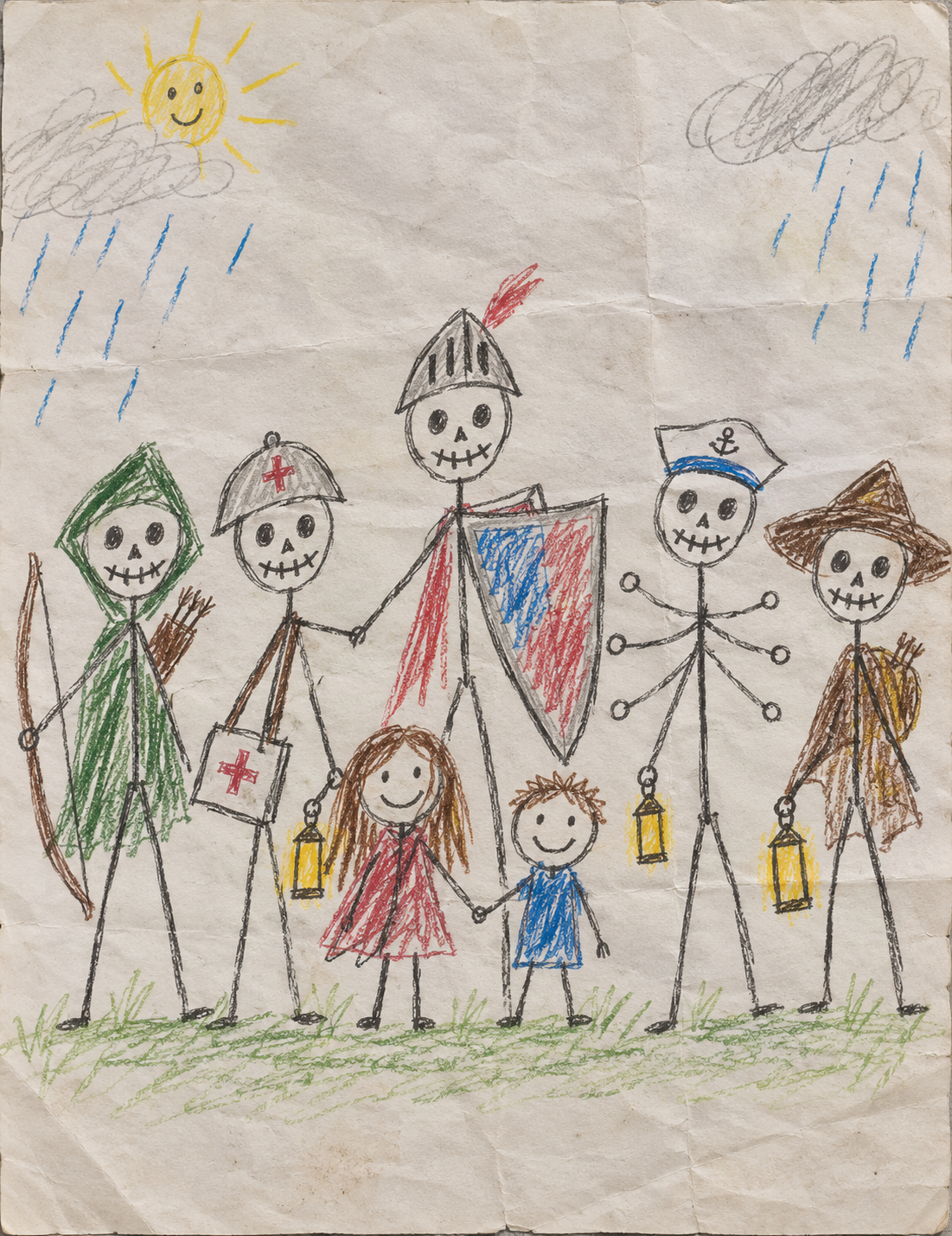
The first time the children returned to the memorial, Kit brought a drawing.
Five stick figures stood around two smaller ones. One had a very large shield. Another had a square bag. All five had enormous smiles, because Kit had not yet learned an easy way to draw a skull.
Nell tucked it into the crack.
“It’s a thank-you,” she told the stone. “You don’t have to come.”
That night, in a place between roads where five lanterns hung from a bare branch, Tomás unfolded the picture.
“A striking likeness.”
Miriam leaned closer.
“You appear to have six arms.”
“Useful aboard ship.”
Oswin took the drawing when Tomás offered it. He studied the two little figures in the middle, their hands joined.
Then he folded it carefully and placed it beneath the strap inside his shield, where the rain could not reach it.
For a little while, they rested.
When the lanterns brightened, Oswin was already reaching for the handle.
Ysabet stood beside him. Miriam fastened her bag. Ada went ahead to find the road, and Tomás lifted the branch so the others could pass beneath it.
All five went together.
The End

