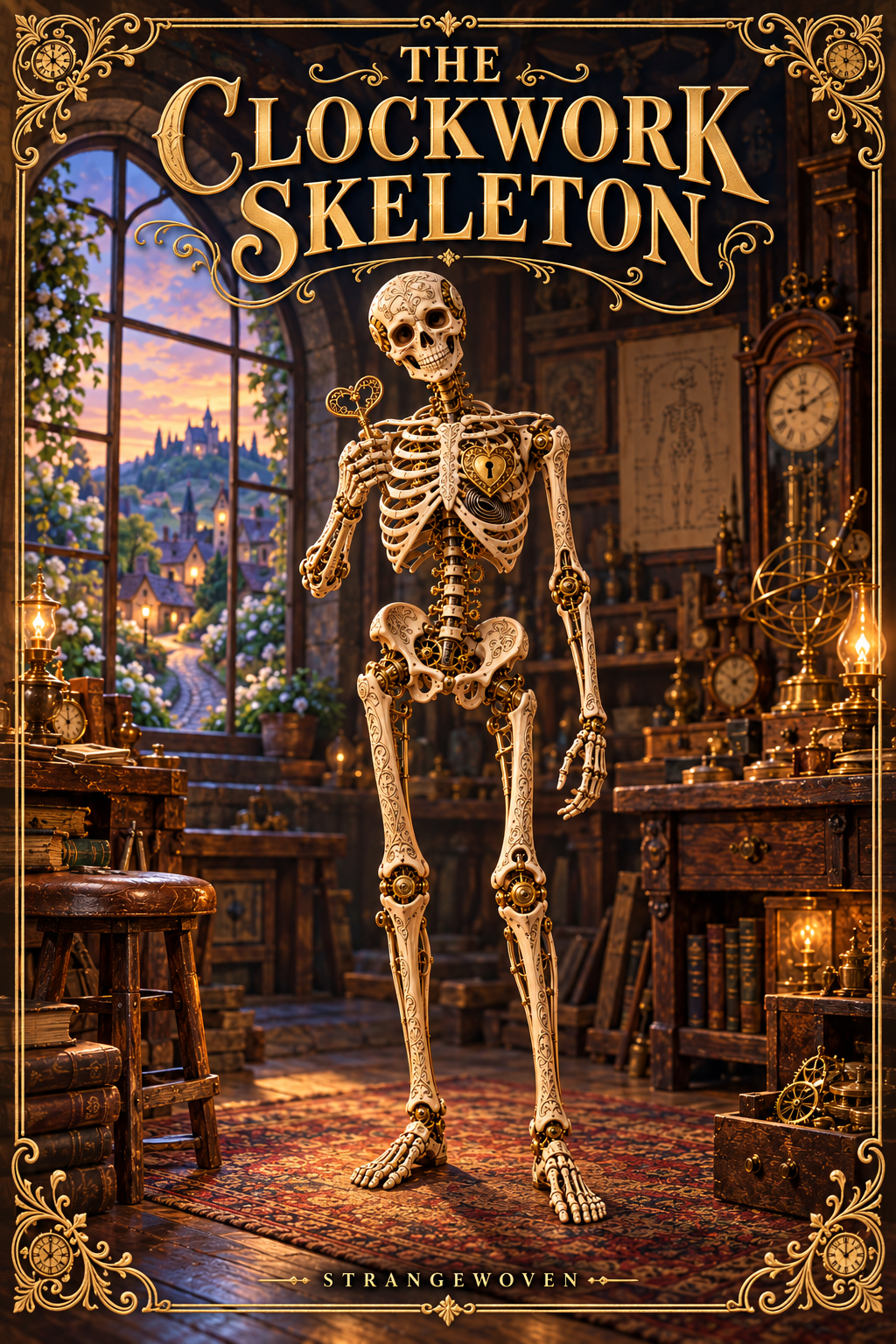
Once upon a time, in a town where the roofs leaned together above narrow streets, there lived a maker of marvelous toys.
She made wooden birds that bowed, tin mice that danced, and little carriages that carried chestnuts across her workbench. But as she grew older, she wished to make something she had never made before.
So she fashioned a skeleton.
She carved every ivory bone with curling leaves and winding vines, down to the smallest bones of his toes. Between them she fitted brass wheels, silver rods, and springs as fine as strands of hair. Through his ribs, anyone could see the machinery turning.
In his chest, where a heart would have been, she placed a keyhole.
For it she made a heart-shaped key, carved so delicately that a thread could pass through its golden curls.
As she tightened the last small screw, she murmured, “Perhaps one day I shall make you a pendulum heart. A little enchantment to catch the motion of the world. Then you would need no winding. You could have a life of your own.”
She did not know that he was already listening.
She turned the key.
The skeleton lifted his head.
“What is a life of my own?” he asked.
The maker dropped her screwdriver.
He was supposed to bow, wave, and recite three cheerful greetings. None of those greetings was a question.
“Well,” she said at last, “I suppose we shall have to find out.”
Every morning she wound him, and every evening his ticking grew faint. His fingers slowed first, then his feet, then his voice. When the spring finally rested, he could still hear and think, but he could neither move nor speak until the key turned again.
At first, the maker left him standing on a shelf with her other toys.
One evening, after winding him, she found him beside the window.
“I hope you don’t mind,” he said. “I wanted to see where the birds went.”
She put a chair there for him.
Soon he had more questions than there were screws in the workshop.
Why did people say they were quite well when their voices trembled? Why did children apologize for crying? Did the maker’s hands hurt when she rubbed them beneath the table?
“Sometimes,” she admitted.
The next morning, he moved the heavy toolbox where she could reach it without lifting.
She searched her drawings for the instruction that had made him do that.
There was no such instruction.
In time, he began carrying finished toys into town. People admired his engraved bones and watched the gears turn through his ribs. Children asked whether he rattled when he sneezed.
“I haven’t learned to sneeze,” he told them. “It sounds rather complicated.”
He liked making them laugh. But when one little girl stood apart from the others, he did not insist she join in.
“Would you like company?” he asked.
She shook her head.
“Then I’ll be at the toy stall, if you change your mind.”
Later, she came and sat beside him.
He learned to mend clock faces, straighten bent axles, and polish tiny bearings. The maker began paying him for his work, and he kept his coins in a blue cup.
“For my pendulum heart,” he explained.
The maker looked toward a drawer beneath her bench.
Inside lay drawings she had begun and put aside. A pendulum was easy enough. A heart that could gather the world’s gentle motion and keep its owner moving was another matter.
“It may take a long time,” she said.
“Then I should like to begin.”
So they began.
For a whole summer they tried silver wire, polished quartz, and a spring wound under moonlight. One heart hummed but would not swing. Another swung but made every clock nearby run backward.
The skeleton found that last result very funny.
The maker did not, until she had corrected all seventeen clocks.
Autumn came, and still he carried the carved key in a little pouch.
He measured his journeys carefully. He knew how much winding would take him to the baker’s door, how much to the bridge, and how much he must keep for the walk home.
One afternoon, with his spring nearly spent, he found the baker sitting behind her shop. An unopened letter lay in her lap.
“Would you like me to fetch someone?” he asked.
“No. Could you sit a moment?”
He looked toward the workshop roof, just visible down the street.
Then he sat.
She spoke of her daughter, who had gone far away, and how proud she was, and how quiet the house had become. He listened until the spaces between his ticks grew long.
“You needn’t hurry,” he began. “I can—”
His spring stopped.
The baker looked up. Then she saw the key pouch beneath his motionless hand.
She fetched the maker, who arrived with her shawl crooked and turned the heart-shaped key.
“—stay,” he finished.
The baker laughed through her tears.
After that, he taught his friends how to wind him and how to recognize when he was growing still. He also learned to say, “I should like to help, but I need winding first.”
Nobody thought less of him for it.
Winter settled over the town.
One evening, he found the maker asleep above the heart drawings. He laid a blanket around her shoulders and sat studying the failed mechanisms.
The next morning, he pointed to a narrow axle.
“When I bend, this catches here. Could we let the pendulum turn freely?”
The maker leaned closer.
Together they built a cradle that could pivot in every direction. They suspended the pendulum within it and fitted a small enchanted crystal above the axle.
The maker lifted it.
The pendulum swung.
She held it still.
It continued swinging, gathering the minute tremors of her hands, the stirring air, the footsteps beyond the door.
They watched it until morning.
Then they watched it for seven days.
On the eighth, the maker said, “I believe it is ready.”
He brought her the blue cup.
She counted out enough coins for the crystal and the silver, then returned the rest.
“You have helped make this,” she said. “But you did not have to buy your place here.”
“Was I ever going to be sold?” he asked.
The maker took his finely carved hand.
“I thought I was making a toy,” she said. “Then you asked me a question. I should have told you sooner.”
That night, he lay upon the workbench beneath a clean cloth. She wound him once more so he could speak while she prepared.
“Will it change what I feel?” he asked.
“Those feelings grew before this heart existed,” she said. “I am only changing what keeps your wheels turning.”
When he was ready, she let the old spring come gently to rest.
He listened as she worked. Small screws clicked into a dish. The familiar winding barrel lifted free. Something new settled beneath his ribs.
For a moment, the workshop was quiet.
Then came a soft, steady tick.
His fingers moved.
He sat up.
Behind his engraved ribs, the little pendulum swung, catching the motion of the room, of the turning earth, of his own delighted hands.
The maker placed the heart-shaped key in his palm.
“Yours to keep.”
He held it for a long while.
In the morning, he walked out through the town and beyond the bridge. At every familiar turning, he listened for the slowing of his spring.
The pendulum kept its rhythm.
He followed a lane he had never dared explore and found a hill covered in small white flowers.
There he sat until the evening birds began their journey home.
He did not count the minutes.
And when he returned, long after the lamps were lit, the maker opened the door.
“How was your day?” she asked.
He hung his carved key beside the window and took his chair.
“I should like to tell you all of it,” he said.
So she put the kettle on.
And he did.

