Stories from a Rook: The First Ten · Story 1
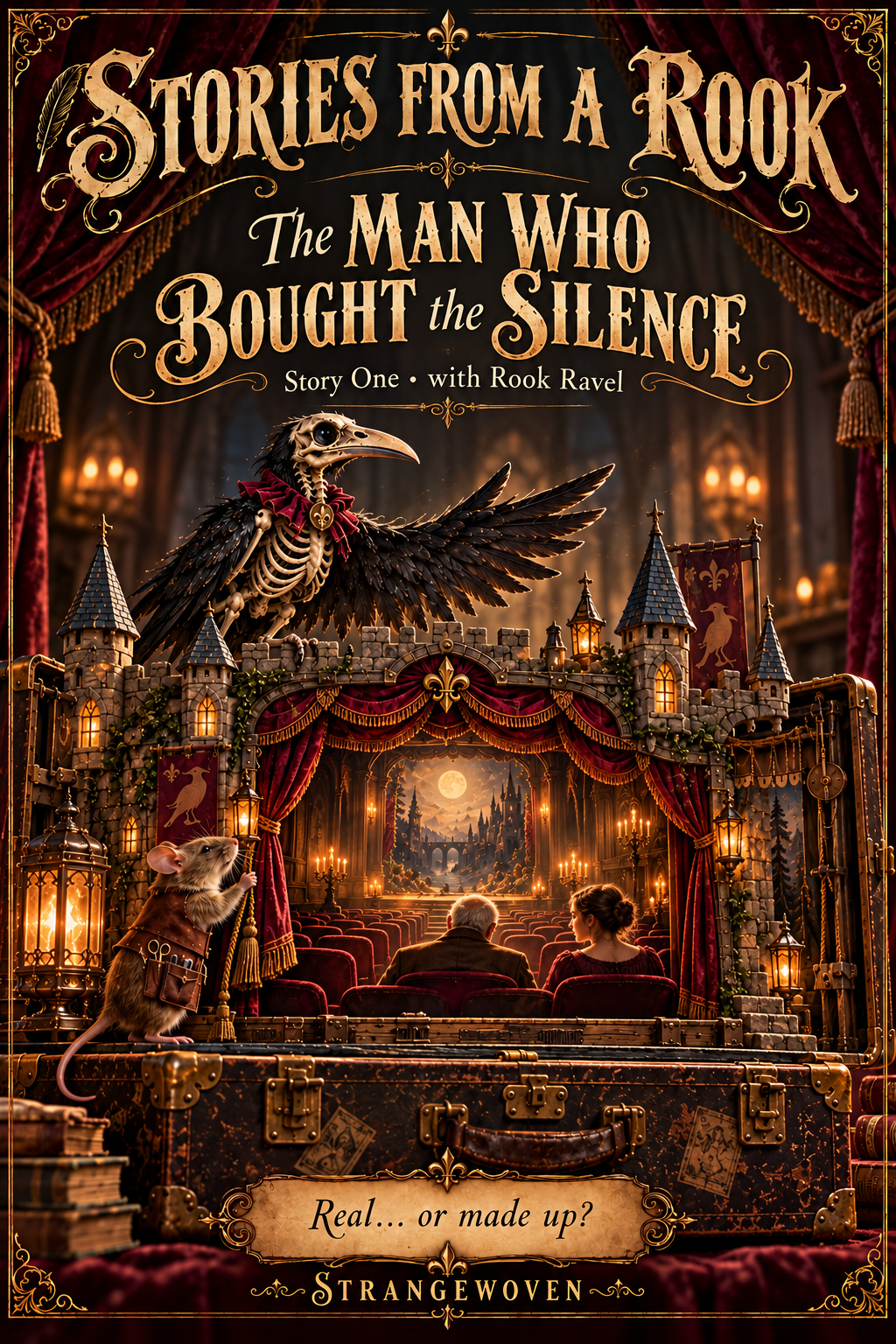
Pip was tightening the last curtain cord when Rook stepped onto the castle battlements.
The little mouse glanced up.
“Not yet.”
Rook held his pose.
Pip tugged the cord, straightened a lantern, and swept a stray feather beneath the stage.
“Now.”
Rook bowed.
“I’m going to tell you a story. Is it real or made up? You decide.”
Behind him, Pip slid a painted street into place.
“There was once a theater that sold a ticket every Thursday to a man who never watched the play.”
Rook folded his wings against his ribs.
“He arrived at precisely seven, wearing a brown coat with one button missing. He paid for the same seat: the last chair in the last row, beside the exit.”
Rook’s chest rose. His head tipped back. Suddenly he was a theater manager, inspecting someone over imaginary spectacles.
“‘You’ll scarcely see a thing from there, sir.’”
His posture changed. His voice became quiet.
“‘That will suit me.’”
The man sat through every performance with his eyes closed.
He never applauded.
He always left before the curtain call.
Naturally, everyone had an explanation.
Rook leaned forward, becoming a whispering usher.
“‘A critic. They send them secretly.’”
He puffed himself up.
“‘A retired actor. Can’t bear to watch anyone else.’”
Then he hunched, voice thin and certain.
“‘He’s asleep.’”
Pip stopped adjusting the backdrop.
“Was he?”
“Someone dropped a scenery flat behind him one evening. He jumped nearly out of his coat.”
Pip nodded and returned to work.
“For eleven months,” Rook continued, “the man came every Thursday. Then a young actress found him waiting outside before the doors opened.”
Rook drew his wings close, taking on her brisk curiosity.
“‘You’ve seen our play six times.’”
A small turn of his skull.
“‘Have I?’”
“‘Don’t you get tired of it?’”
“‘I don’t listen to the play.’”
The actress looked at the theater doors.
“‘Then what do you listen to?’”
For the first time, the man smiled.
“‘The room.’”
Pip slowly lowered a tiny stage broom.
Rook let the silence settle.
“The actress had heard some strange things in her profession. She waited.”
The man explained that his wife had worked in that theater for thirty-eight years. She had mended costumes, found missing props, and persuaded frightened children to step out beneath the lights.
On Thursdays, he used to collect her after work.
He would wait in the last row.
Even after thirty-eight years, she always had one more thing to finish.
“‘From that chair,’” Rook said in the man’s voice, “‘you can hear the dressing-room stairs. The pipes knock when someone turns on the upstairs tap. And just before a scene begins, there’s usually someone running very quietly.’”
He paused.
“‘She’s been gone nearly a year. At home, I keep listening for her key in the door. Here, there’s always another sound coming.’”
The actress sat beside him until the doors opened.
Afterward, she told the manager.
And the manager, who was kinder than he was sensible, decided they should do something special.
The following Thursday, the company invited the man onto the stage. They presented him with flowers and announced that his seat would be free for life.
Everyone applauded.
Rook spread his wings, filling the little castle with the shape of a grand occasion.
Then he lowered them.
“The man thanked them very politely.”
Pip looked up.
“But he didn’t come back?”
“No.”
For three Thursdays, the chair remained empty.
Finally, the young actress went to his house.
Rook became her again, standing awkwardly on a doorstep.
“‘We meant to make you feel welcome.’”
“‘You did.’”
“‘Then why have you stopped coming?’”
The man looked down at his hands.
“‘I could manage buying a ticket,’ he said. ‘I didn’t know how to manage everyone watching me miss her.’”
Pip set the broom down.
“The actress went back to the theater,” Rook said. “She spoke to the manager. The manager spoke to the ushers.”
“And?”
“The next Thursday, when the man approached the ticket window, the clerk held out her hand.”
Rook adopted her businesslike voice.
“‘One ticket?’”
“‘Please.’”
“‘Last row?’”
“‘Please.’”
She took his money.
Nobody turned to watch him enter.
Nobody asked how he was feeling.
And halfway through the second act, a young actress came down the aisle and sat beside him.
She said nothing.
After a while, he moved his coat so she had a little more room.
Rook fell quiet.
Behind him, Pip left the painted theater standing beneath its tiny lantern.
“Did he keep coming?” the mouse asked.
“For years, according to the story.”
“And the actress?”
“When she could.”
Pip considered this.
“I think that one happened.”
Rook tipped his skull.
“Because of the flowers?”
“No. Because they got it wrong before they got it right.”
Rook gave the mouse a small bow.
Then he turned to his audience.
“Well?”
His shadow stretched across the castle towers.
“Real… or made up?”

