Spoilers ahead. Make your guesses before opening the posters or reading the answer notes below.
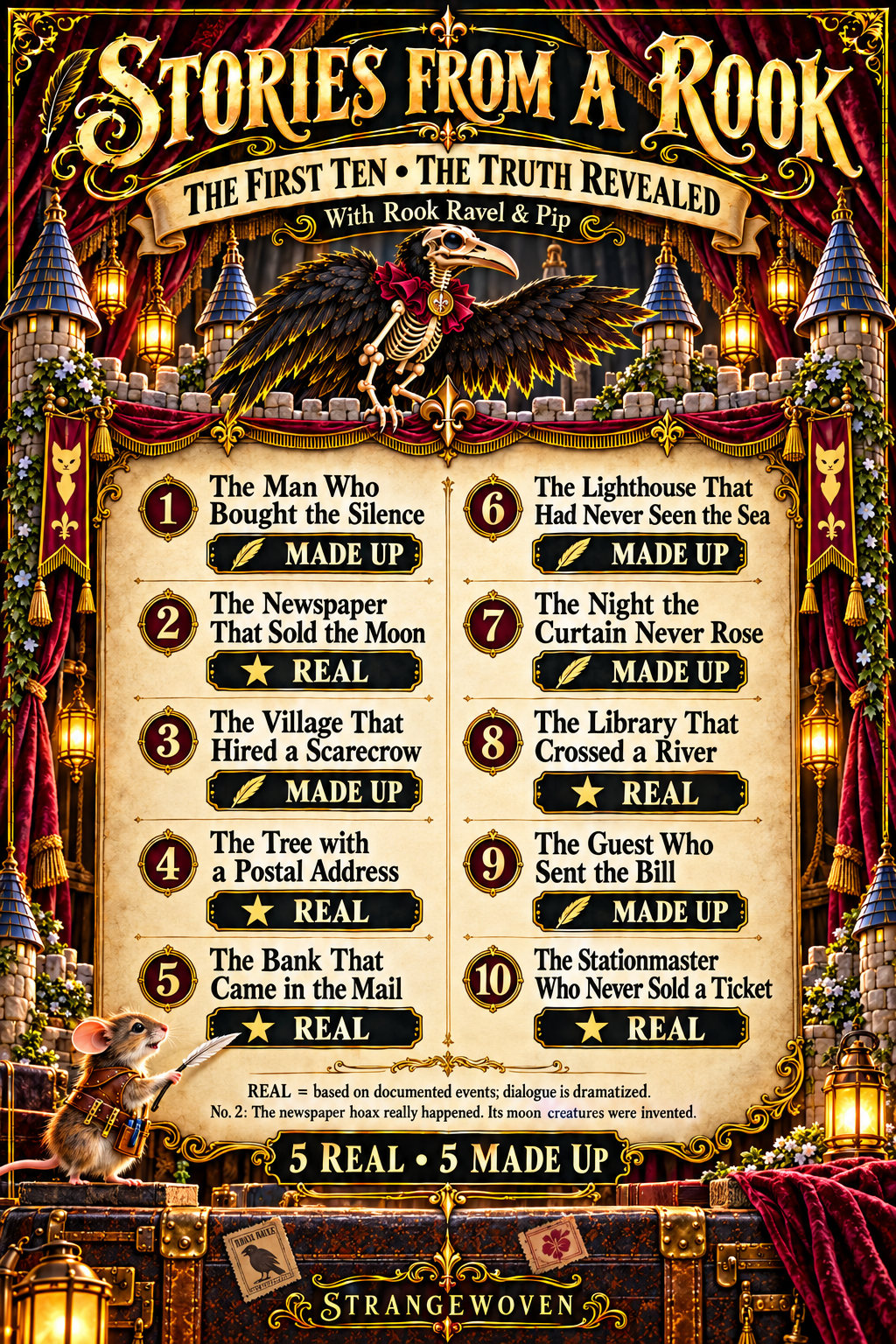
Reveal the numbered answer poster
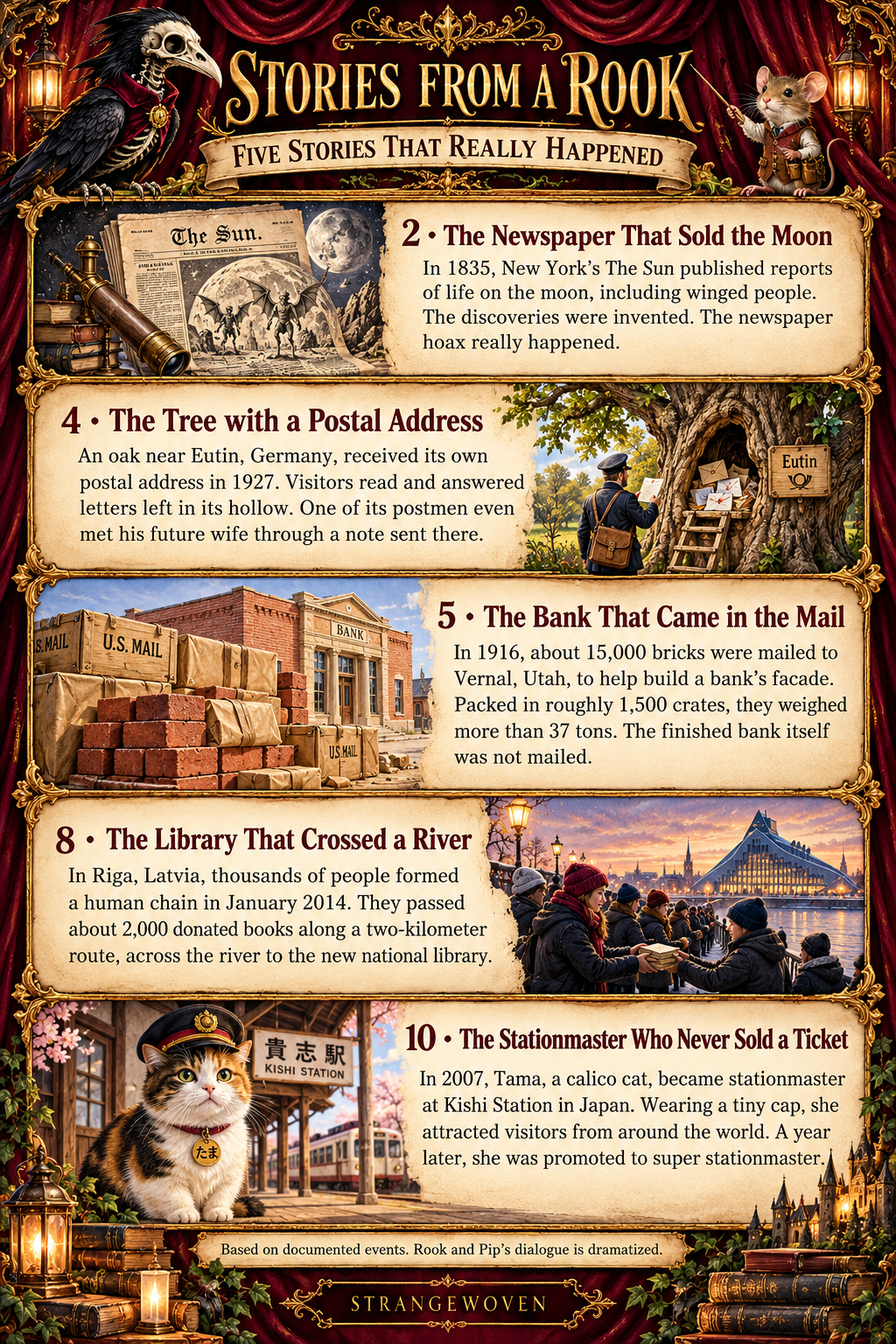
Read the five true stories in brief
Answers and research notes
REAL means the story is based on documented events. Rook and Pip’s dialogue and performances are dramatized.
01 — The Man Who Bought the Silence
Reveal this story’s answer
Made up. This is an original fictional story.
02 — The Newspaper That Sold the Moon
Reveal this story’s answer
Real, as a dramatized historical retelling. The New York Sun published the six-part Great Moon Hoax in August 1835, falsely linking fantastical lunar discoveries to John Herschel. The lunar life was invented; the newspaper episode happened. Rook, Pip, their stage business, and the illustrative street dialogue are fictional. Claims about exactly how many readers believed the reports should be treated cautiously.
Sources: – Library of Congress, “Belief, Legend, and the Great Moon Hoax”: https://blogs.loc.gov/folklife/2014/08/the-great-moon-hoax/ – William L. Clements Library, University of Michigan, “Life on the Moon in Two Acts”: https://clements.umich.edu/publication/the-heavens/life-on-the-moon/
03 — The Village That Hired a Scarecrow
Reveal this story’s answer
Made up. This is an original fictional tale written for Stories from a Rook. The village, scarecrow appointment, incidents, and council accounts are invented. Rook’s final question concerns whether the village episode happened; the identity of whoever moved the scarecrow remains an additional mystery within the fiction.
04 — The Tree with a Postal Address
Reveal this story’s answer
Real, as a dramatized retelling. The Bridegroom’s Oak near Eutin, Germany, has an established tradition of receiving letters in a hollow in its trunk and was given a postal address in 1927. Visitors can read and answer letters. USPS also reports that former carrier Karl-Heinz Martens met his future wife Renate through a note addressed to him at the tree. The earlier secret-courtship origin is presented here as a local tale, rather than independently established history.
Rook, Pip, the stage action, and all performed dialogue are fictional. No performed dialogue is a historical quotation.
Sources: – USPS Employee News, “Beloved botanical”: https://news.usps.com/2022/02/11/beloved-botanical/ – Eutin municipal English visitor information, “Bride-groom oak-tree”: https://www.vg-eutin-suesel.de/Stadt-Eutin/English-page.php?object=tx%2C1039.206.1
05 — The Bank That Came in the Mail
Reveal this story’s answer
Real, as a dramatized historical retelling. In 1916, approximately 15,000 pressed bricks for the Bank of Vernal’s facade were shipped by Parcel Post in roughly 1,500 crates weighing about 37½ tons. Most of the building used local bricks: an entire finished bank was not mailed. USPS dates completion of the brickwork to November 1916 and the bank’s move to February 1917.
The November 1916 policy required prior approval for more than 200 pounds of nonperishable merchandise from one sender to one addressee in one day. It clarified an existing requirement concerning unusually large shipments; it was not a simple permanent ban on mailing bricks.
Rook, Pip, their props, and all performed dialogue are fictional. No dialogue is a historical quotation. Popular accounts differ on quantities and transport details; this retelling follows the USPS historian’s account and the Smithsonian’s collection record.
Sources: – USPS Historian, “The Bank of Vernal: The ‘Parcel Post Bank’”: https://about.usps.com/who-we-are/postal-history/bank-of-vernal.pdf – Smithsonian National Postal Museum, “The Bank of Vernal brick”: https://postalmuseum.si.edu/object/npm_2022.2007.1
06 — The Lighthouse That Had Never Seen the Sea
Reveal this story’s answer
Made up. This is an original fictional story for Stories from a Rook. The sailor, lighthouse, quarry-road rescue, and volunteer keepers are invented.
07 — The Night the Curtain Never Rose
Reveal this story’s answer
Made up. This is an original fictional story for Stories from a Rook. The theater, stranded company, emergency performance, and subsequent advertisement are invented. The performed dialogue is original, not a historical quotation.
08 — The Library That Crossed a River
Reveal this story’s answer
Real, as a dramatized historical retelling. On January 18, 2014, a human chain in Riga passed roughly 2,000 donated books along an approximately two-kilometer route from the National Library of Latvia’s old building to its new home, across the Daugava River. The library’s contemporary account reports more than 14,000 participants over about five hours. This was a symbolic celebration, not the transport of the entire collection or an emergency replacement for ordinary moving services. The books carried donors’ personal messages.
Rook, Pip, their stage action, the illustrative figures Rook portrays, and all dialogue are fictional. The passage beginning “Imagine receiving one” is an imagined illustration, not a claim about an identified participant.
Sources: – National Library of Latvia’s January 20, 2014, statement of thanks, published on Biblioteka.lv: https://www.biblioteka.lv/nacionala-biblioteka-izsaka-pateicibu-par-piedalisanos-akcija-gramatu-draugu-kede-articleitem-25143/ – Latvian Ministry of Culture, January 11, 2024, tenth-anniversary notice: https://www.km.gov.lv/lv/jaunums/gramatu-draugu-kedes-desmitgades-atzimesana-latvijas-nacionalaja-biblioteka
09 — The Guest Who Sent the Bill
Reveal this story’s answer
Made up. This is an original fictional story for Stories from a Rook. The hotel, actor, porter, invoice, correspondence, and subsequent acting engagement are invented. Rook’s dialogue does not establish that this actor was his former owner. All performed dialogue is original, not a historical quotation.
10 — The Stationmaster Who Never Sold a Ticket
Reveal this story’s answer
Real, as a dramatized historical retelling. Tama was appointed stationmaster of Kishi Station on January 5, 2007. Wakayama Electric Railway records her promotion to super stationmaster on January 5, 2008. She attracted visitors, received further honorary promotions, and inspired themed trains and a station redesign. Her role was as a celebrated animal ambassador, not as an operator of trains or railway safety equipment. The railway’s revival involved people, investment, and other measures as well as Tama’s popularity.
Rook, Pip, their stage action, and all performed passenger dialogue are fictional. The imagined camera behavior is theatrical characterization, not a report of a particular observed episode. This story concerns Tama’s historical tenure, not the railway’s current feline staff or visiting arrangements.
Sources: – Wakayama Electric Railway, “Cat Stationmaster,” including Tama’s historical timeline: https://wakayama-dentetsu.co.jp/cat-stationmaster/ – Japan National Tourism Organization, “The Cat Stationmaster of Kishi Station”: https://www.japan.travel/en/japans-local-treasures/cat-stationmaster-kishi-station-2022/

