Dock Twenty-Seven
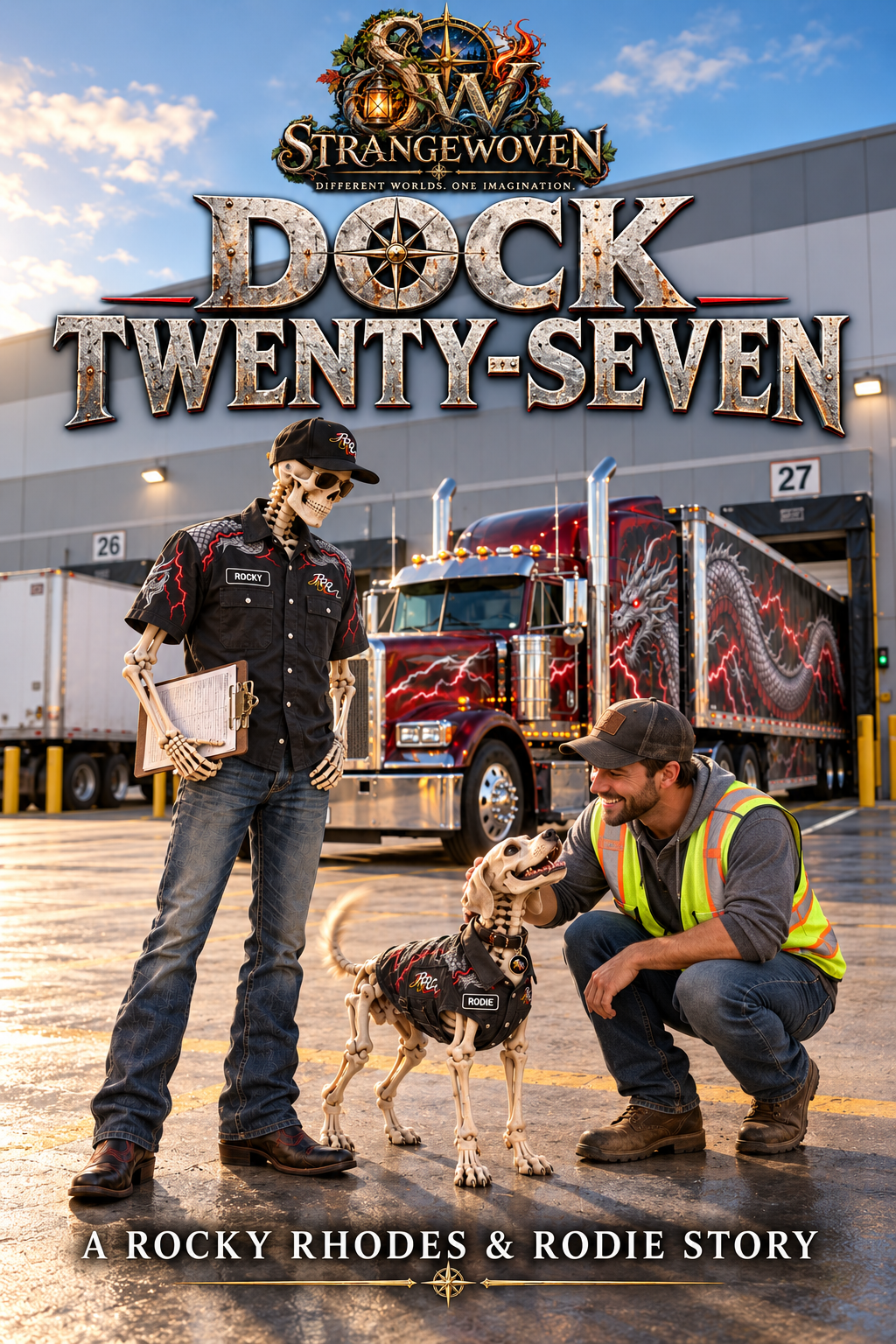
Rocky Rhodes & Rodie · Story Two
← Read Story One: The Green Detour
Two days after becoming a skeleton, I discovered the freight industry had a higher tolerance for the supernatural than it did for incomplete paperwork.
My delivery appointment was at eight in the morning. I reached the distribution center at 7:43, which in trucking meant I was either seventeen minutes early or already three hours late, depending on which person in the building answered the phone.
The guard shack stood between two concrete barriers at the entrance. I stopped beside the call box and lowered my window.
Rodie sat in the passenger seat wearing his charcoal work vest. His tail clicked against the door while he watched two yard tractors hustle trailers around the property.
“Settle,” I told him.
The clicking stopped.
I pressed the call button.
“Driver’s name?” a woman asked through the speaker.
“Rocky Rhodes.”
“Company?”
I gave her the information.
“Appointment time?”
“Eight o’clock.”
“Pickup number?”
“Delivery.”
There was a pause.
“Then I need the purchase order.”
I looked at the bills on the passenger seat. Rodie put one paw on the corner as if he had been assigned document control.
“I have six numbers on three pages,” I said. “Would you like the long one, the short one, or the one somebody wrote sideways in blue ink?”
“Start with the long one.”
I read it to her.
Another pause followed. The security camera above the call box turned toward my window.
It moved a little farther.
Then it moved back.
“Sir?”
“Still here.”
“Are you wearing a mask?”
“No.”
“Is this some kind of promotional thing?”
I glanced at my reflection in the side mirror.
“Not intentionally.”
The speaker clicked off.
Rodie looked at me.
“I thought that went well.”
His tail tapped the door once.
A minute later, the guard-shack door opened. A woman in a reflective vest stepped outside holding a clipboard against her chest. She stopped several feet from the truck and studied me through the open window.
“Rocky?”
“That’s me.”
“You sounded normal over the speaker.”
“I’ve been practicing.”
She looked toward Rodie.
He wagged immediately and gave one happy bark.
“That your dog?” she asked.
“Unless somebody switched him during the detour.”
Rodie leaned forward, eager to meet her, but stayed in his seat.
The guard stared at us for another moment. Then she took a slow breath and stepped closer.
“I’m Elena,” she said.
“Nice to meet you.”
“I’m trying very hard to act like this happens all the time.”
“You’re doing better than I did.”
That earned the beginning of a smile.
She checked the paperwork through the window without touching my hand. I couldn’t blame her. I was still getting used to touching my own face.
“The last digit is smeared,” she said.
“Of course it is.”
“I can’t find the load without it.”
“I crossed three states with forty-two thousand pounds of paper towels, but one blurry number is where the journey ends.”
“Park in staging while I call receiving.”
She pointed toward a row of numbered spaces.
“Good news,” I told Rodie as we rolled through the gate. “They’re willing to overlook the skeleton. The paperwork remains unacceptable.”
The staging area held nine trucks and enough empty pavement to make every driver park at a different angle. I chose a space near the end, set the brakes, and turned up the CB.
“Anybody know whether they’re running on time?” a driver asked.
Someone answered, “Depends. What day was your appointment?”
“Today.”
“Then no.”
I rested an elbow beside the window. Rodie watched the yard through the windshield, his tail sweeping slowly across the seat.
A white tractor pulled past us and stopped at an angle near dock twenty-six. The driver backed toward the building, corrected, backed again, and ended up farther from the dock than when he started.
He pulled forward for another attempt.
Nobody is born knowing how to back a trailer. Every experienced driver has a collection of early mistakes they prefer to call training. Mine included a crooked dock, an audience of six drivers, and a trash can that had been placed in an unreasonable location.
The white truck tried again.
The trailer began drifting toward the painted line on the passenger side.
I picked up the microphone.
“White tractor backing twenty-six, you have a radio on?”
After a moment, a nervous voice answered. “Yeah.”
“You’re losing the passenger side. Stop there.”
The truck stopped.
“Pull forward about six feet and bring the tractor slightly left. Don’t chase the trailer too hard.”
He followed the directions.
“That’s better. Start bringing it around. Slow. You’ve got room.”
The trailer straightened.
“Hold that line. Now follow it back.”
He eased into the dock and stopped between the stripes.
“Am I in?” he asked.
“Close enough that nobody needs to rewrite the building.”
The driver laughed with relief.
“Thank you. First week solo.”
“We’ve all had a first week.”
“Which truck are you in?”
I looked across the staging lot at several ordinary tractors and then at the dragon covering the side of mine.
“You’ll figure it out.”
Rodie barked once, apparently pleased with my answer.
Ten minutes later, the driver walked across the lot toward us. He was young, probably in his twenties, and still wore his reflective vest even though he was nowhere near traffic. He raised one hand as he approached.
Then he saw me.
His step shortened, but he didn’t stop.
I leaned out the window. “First week gets stranger from here.”
He stared for half a second, then laughed.
“You’re the one who talked me in?”
“That was me.”
“I’m Caleb.”
“Rocky. The supervisor in the passenger seat is Rodie.”
Rodie stood, wagging so hard that his vest shifted across his ribs.
“Can I meet him?” Caleb asked.
“Rodie, okay.”
Rodie climbed down using the passenger-side steps and trotted around the front of the truck. He stopped in front of Caleb, looked back at me, and waited.
“Go say hello.”
His tail became a blur of clicking bones. He gave an excited bark and pushed his skull beneath Caleb’s hand.
Caleb hesitated before rubbing the top of Rodie’s head.
“He acts like a regular dog.”
“He is a regular dog. His packaging changed.”
Rodie leaned against Caleb’s leg.
“Friendly too.”
“I’ve been trying to teach him to be distant and mysterious. He refuses.”
Elena’s voice came over the yard radio clipped to a nearby post, calling for my truck to return to the guard shack.
“Rodie, load up.”
He immediately left Caleb, climbed back into the cab, and settled on his seat.
Caleb watched him go. “That’s a good dog.”
“He’ll be expecting that in writing.”
Back at the gate, Elena handed me a visitor sheet and the corrected purchase-order number.
“Receiving found your appointment,” she said. “Dock twenty-seven.”
“Right beside the one we just practiced on.”
“You know the other driver?”
“I do now.”
She looked through the window at Rodie, who had begun wagging again.
“May I?”
I gave him permission, and he leaned toward her open hand. Elena gently touched the side of his skull.
“That is going to take some getting used to,” she said.
“We’re accepting applications for people willing to try.”
At dock twenty-seven, I backed between the lines, felt the trailer meet the rubber bumpers, and set the brakes. A warehouse supervisor came outside to check the seal.
He looked at the seal.
He looked at me.
Then he looked at the seal again.
“You the driver?”
“That’s what the paperwork claims.”
He inspected the number and wrote it on his clipboard.
“Seal matches. You were on time. I don’t care what else you’ve got going on.”
It was the most comforting thing anybody had said to me since the detour.
They unloaded the trailer while Rodie and I waited in the cab. The white tractor remained beside us, and Caleb occasionally asked questions over the CB—how much room to leave before turning, when to use a pull-up, how to judge the trailer from the mirrors.
I answered what I could.
Another driver joined the conversation and asked, “Rocky, is it true you’re a skeleton?”
“That depends. Are you from receiving?”
“No.”
“Then yes.”
“How are you talking?”
“Same way you are. Too much and over the radio.”
The channel filled with laughter.
Nobody asked whether I was dangerous. Nobody demanded an explanation I didn’t have. For several minutes, we were simply drivers waiting for green lights above our docks, passing time the way drivers always had.
Rodie rested his chin on the edge of the passenger seat and listened to the voices. Whenever Caleb spoke, his tail tapped once.
The dock light finally changed.
I collected the signed bills and returned to the guard shack. Elena checked my trailer, opened the exit gate, and handed the paperwork back through the window.
“You coming through here again?” she asked.
“If dispatch believes in second chances.”
“I think people will get used to you.”
Rodie barked.
Elena smiled. “They’ll get used to him first.”
“That was always going to happen.”
I pulled onto the access road and turned toward the highway. Rodie watched the distribution center disappear through the passenger window.
The delivery had taken almost four hours. Nobody had explained the road, the green light, or what had happened to us.
But the load was empty, the bills were signed, and one new driver had reached his dock without removing any paint from the building.
For that morning, it was enough.
Becoming a skeleton had changed many things.
Receiving still needed the correct number.

