The first thing Orin Veylan fixed at Calder House was a cupboard hinge.
The woman in apartment 214 had reported it three times. By the time he arrived, she was holding the cupboard shut with a shoelace.
“They said it wasn’t urgent,” she told him.
Orin set his tool bag on the floor.
“Depends what’s falling out of it.”
“Mostly plates.”
“Then we’ll promote it.”
Her name was Mrs. Pell. She insisted on feeding him afterward. He accepted half a sandwich and left with a list of four other things she had stopped bothering to report.
That was how he learned the building.
Not from its plans. Those showed doors that had been sealed years ago and a laundry room that was now somebody’s office. He learned it through the people who lived there: which resident worked nights, which hallway light frightened a man with poor sight, which stair landing offered a place to rest.
He learned its faults the same way.
He photographed cracks. He dated reports. When a door closer broke, he repaired it. When a problem was beyond his qualifications, he called someone who had them.
The cracks beneath the west stairwell were beyond his qualifications.
He reported them on Monday.
On Thursday, an office told him they would arrange an inspection.
On Friday, he called again.
By Saturday evening, rain had been running down the inside of the west stairwell for six hours.
Orin was in the basement when he heard the first sharp report above him.
He stopped with a wrench in his hand.
Dust sifted from the ceiling.
Then came another sound, deeper and longer, and the building moved beneath his boots.
He reached the ground floor as somebody screamed upstairs.
Orin called emergency services, gave the address, and described what he had heard. Then he pulled the alarm.
The corridor filled with noise and opening doors.
“East stairs,” he told the people coming toward him. “Stay away from the west side. Straight outside, please.”
He sent a resident to meet the arriving crews. Another held the front door and directed people across the street.
Orin checked the ground-floor rooms as he worked toward the east stairwell.
At the second landing, Mrs. Pell stood clutching the rail.
“My legs,” she said, furious with them.
“We’ll take our time.”
“I don’t think the building will.”
“Then it’ll have to complain to me.”
He put her arm across his shoulders. A young man coming down behind them took her other side.
Together, they reached the street.
Firefighters were arriving. Orin told one about the stairs, the cracks, and the residents who might still be upstairs.
Then a man in slippers caught his sleeve.
“My brother. Tomas. Third floor. He was behind me.”
Orin looked up.
Through a third-floor window, a hand struck the glass.
He pointed it out to the firefighter.
“East corridor,” Orin said. “There’s a service door through the old laundry. I have the key.”
He went as far as the entrance with the key held out. Before anyone could take it, a fresh shower of masonry drove them back from the west corner.
The street filled with dust.
Orin could no longer see the window.
He should have waited for the crew to regroup. Later, he would remember that clearly.
Instead, he went inside.
He took the emergency lantern from its charging bracket beside the basement door and climbed.
The east staircase held. At the third floor, the service door opened with the same stubborn scrape it always had.
Beyond it, a section of ceiling had fallen across the corridor.
“Tomas?”
“Here.”
The answer came from the other side.
Orin squeezed past a buckled cabinet and found him sitting beneath an intact portion of ceiling. His ankle had swollen above his slipper.
“Your brother sent me.”
“Can you get me out?”
Orin examined the way back.
“I can help you move. We’ll do that first.”
Tomas nodded.
They made it to the service doorway as the floor behind them dropped.
The frame twisted. Orin pushed Tomas through, then wedged his shoulder beneath the sagging lintel.
It was an absurd thing to do. He was a man holding up more weight than a man could hold.
For a moment, it worked anyway.
Someone on the stairs shouted. Hands reached for Tomas.
The lantern slipped from Orin’s grip. It struck the landing and continued to shine.
He watched Tomas disappear down the stairs between two rescuers.
Only then did he try to move.
The doorway came down.
When Orin opened his eyes, he was lying in darkness.
He could feel the rough floor under his cheek. He could not feel the weight that ought to have been crushing him.
Several feet away, the lantern lay on its side.
He reached toward it.
Light showed through his fingers.
He withdrew his hand. The light came with it.
Under the skin, each bone stood out in warm ivory. He pressed his other hand over the first, then pulled his coat sleeve down. A thin glow escaped through the cuff.
“No,” he said.
It was the only useful word he could find.
A faint pressure stirred beneath his ribs.
He turned toward it.
Somewhere beyond the rubble, someone was alive.
He did not hear a voice. He felt an urgent, uneven presence, like a knock transmitted through a wall.
Orin got to his knees.
The corridor was gone. A broken slab stood between him and the stairs. When he touched it, fine lines of light spread from his palm, following its edges.
Beyond the slab, he could see the outline of a passage.
He moved his foot toward it.
The darkness beneath his boot became solid.
He paused, breathing hard, and shifted his weight.
The step held.
Another appeared when he reached for it. Then another.
He followed them through a space that had no business admitting him, one hand against a luminous wall. Behind him, the steps remained, pale and narrow.
At the bottom, a firefighter was crouched beside a fallen beam. Part of her coat was pinned beneath it.
She stared at Orin.
He stared back.
“I know,” he said.
“Can you lift this?”
It was a practical question. He was grateful for it.
He gripped the beam. Light brightened in his wrists, and the weight came up far enough for her to pull free.
She rose and tested her leg.
“Anyone with you?” she asked.
He shook his head, then stopped.
The pressure beneath his ribs had faded. He turned slowly, searching for it again.
“I don’t think so.”
The uncertainty hurt more than the light in his hands.
“We get out,” she said. “Then we work from outside.”
He retrieved his lantern. She followed him onto the glowing steps.
Halfway up, they flickered.
Orin’s knees weakened.
The firefighter caught his elbow.
“Keep moving.”
“Trying.”
They emerged into rain through a gap beside the front entrance.
Orin took one more step. The light went out, and he fell.
He woke in a hospital bed with an ordinary blanket over him and extraordinary things happening beneath it.
His hands glowed faintly.
A doctor asked questions. Orin answered the ones he could. Nobody had a satisfactory explanation for the rest.
The firefighter visited that afternoon. Her name was Mara Dace.
She placed his battered lantern on the bedside table.
“Tomas is alive,” she said. “His brother wanted you to know.”
Orin shut his eyes.
“The others?”
She drew a chair closer and told him what they knew, what they had checked, and what work remained.
He listened without interrupting.
Afterward, she nodded toward his hands.
“Those stairs nearly disappeared with us on them.”
“I didn’t know they could.”
“Now you do.”
He looked at her.
“You also knew we were coming,” she said. “You went in anyway.”
“He was at the window.”
“I understand why. I’m asking you to understand what it could have cost.”
Orin glanced at the lantern. Its casing was dented where he had dropped it.
“Yes,” he said at last.
Mara stayed until his lunch arrived.
Recovery gave him time to be frightened.
In the bathroom mirror, his face was still his own, but ivory lines showed beneath his cheek and jaw. The glow became brighter when he concentrated and dimmer when he was tired.
Sleep restored it.
Using it spent it.
He began keeping notes.
He tested small things: a light left on a scrap of wood, a cracked tile held together, the lantern glowing after he had removed its ruined battery.
He stopped before exhaustion, except once.
That time, he spent an hour on the kitchen floor waiting for his legs to obey him.
In his notebook, he underlined a sentence twice.
Leave enough to get yourself out.
Mrs. Pell visited his new apartment with a casserole and a bag containing the coat he had worn at Calder House.
She had repaired what she could.
“You’re staring,” she told him.
“It was nearly in pieces.”
“So were you. Apparently we’re keeping both.”
He ran his fingers over the repaired shoulder.
Later, he reinforced the seams himself. Light followed the stitches when he touched them, settling into clean angles around the cuffs and chest.
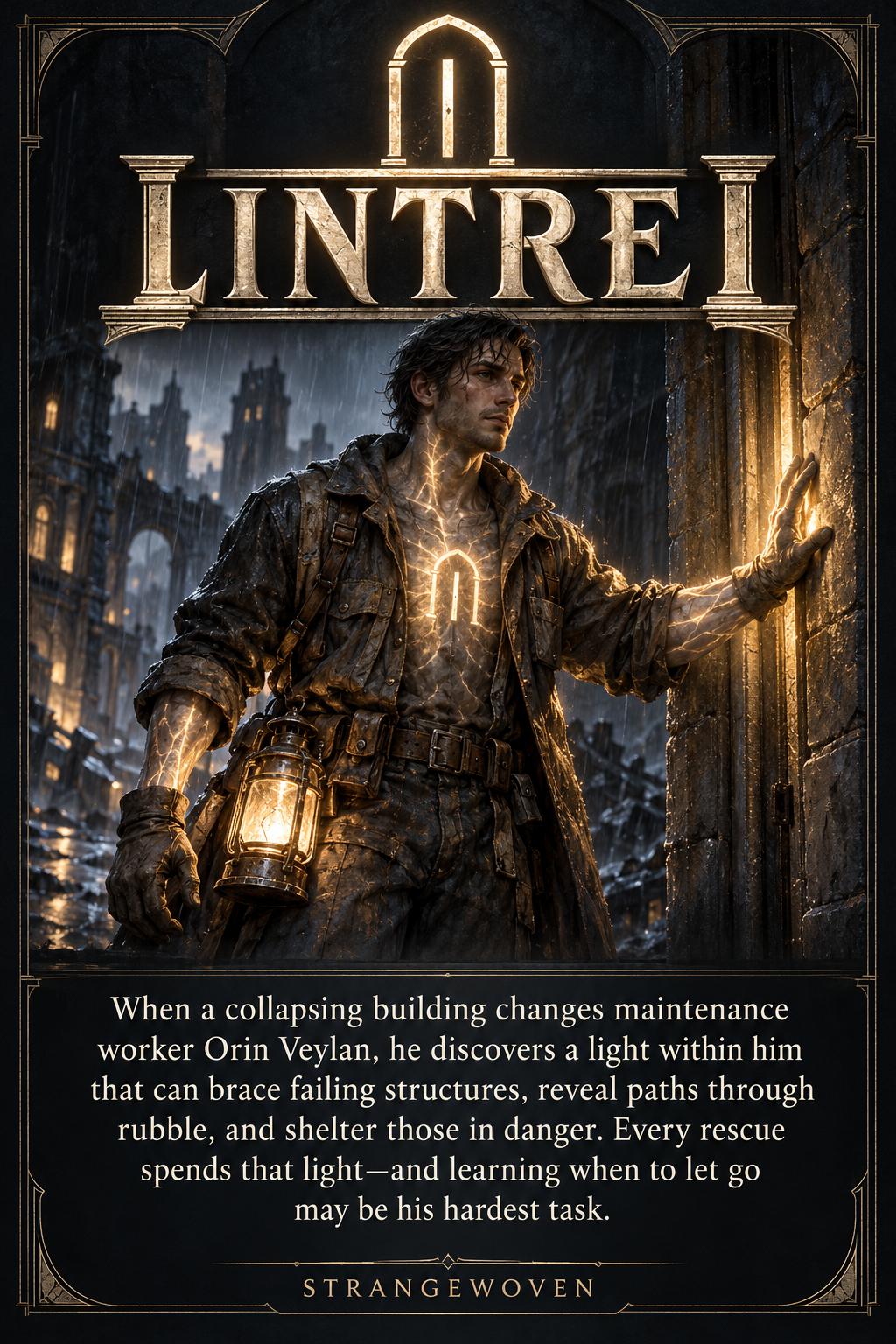
Over his heart, he sewed a small doorway with a single upright line inside it.
He had no name for what he was becoming.
He knew what the doorway meant.
Eleven days after Calder House, a burst water main undermined a row of shops.
Orin was two streets away when he felt the pressure beneath his ribs.
He called for help as he ran.
At a tailoring shop, the front floor had sunk. A woman stood on an island of boards beside her cutting table, unable to reach the entrance.
Orin set his lantern outside.
“Keep people back,” he told the man beside the door.
Then he stepped onto the first line of light.
Each step formed beneath his boot. He crossed the gap before turning to the woman.
“It held me,” he said. “Let me help you across.”
She took his hand.
They were halfway back when the window frame split above them.
Orin raised his free arm. A curved shelter of light caught the falling glass.
His legs trembled immediately.
Too much at once.
He let the shelter fade as the last fragments slid away and concentrated on the steps.
The woman reached the threshold.
Someone outside took her hand.
The shop gave a long, splintering groan.
Orin caught the frame with both hands.
Light spread through the doorway and down into the broken floor. He felt himself fasten in place. He could hold it, but he could no longer lift a foot.
“She’s out,” a voice told him.
He tried to turn.
“She’s out, Orin.”
Mara stood beyond the threshold.
“Let go. Come toward me.”
For one terrible moment, he wanted to check again.
Then he trusted her.
He released the frame and stumbled forward. Mara and another responder caught him as the light vanished behind his heels.
They helped him sit across the street.
The tailor brought his lantern over and set it beside him. A little light remained inside.
“What do we call you?” she asked.
“Orin.”
“I mean when you do this.”
He looked at the shop doorway.
The beam above it had held.
“A lintel holds the top of a door,” he said, still catching his breath. “I used to replace them.”
“Lintel?”
He considered the word. Then, quietly, changed it.
“Lintrel.”
She repeated it and smiled.
Mara handed him a bottle of water.
“All right, Lintrel. Next time, leave enough for the walk home.”
He accepted the bottle.
“Working on that.”
That evening, Orin sat at his kitchen table with his notebook open.
He wrote down what had happened at the shop, including the moment he had nearly refused to let go.
Then he took out his photographs of Calder House.
The cracks. The water damage. The dated reports.
He arranged them beside the notebook and began making calls. Whatever his light could do, it would never be enough to hold every neglected building in the city.
Someone still had to answer for the things that could have been prevented.
By midnight, his hands were shining softly again.
He checked the lantern, hung his repaired coat beside the door, and went to bed.
For tonight, he had done what he could.
He was learning that this, too, took courage.

