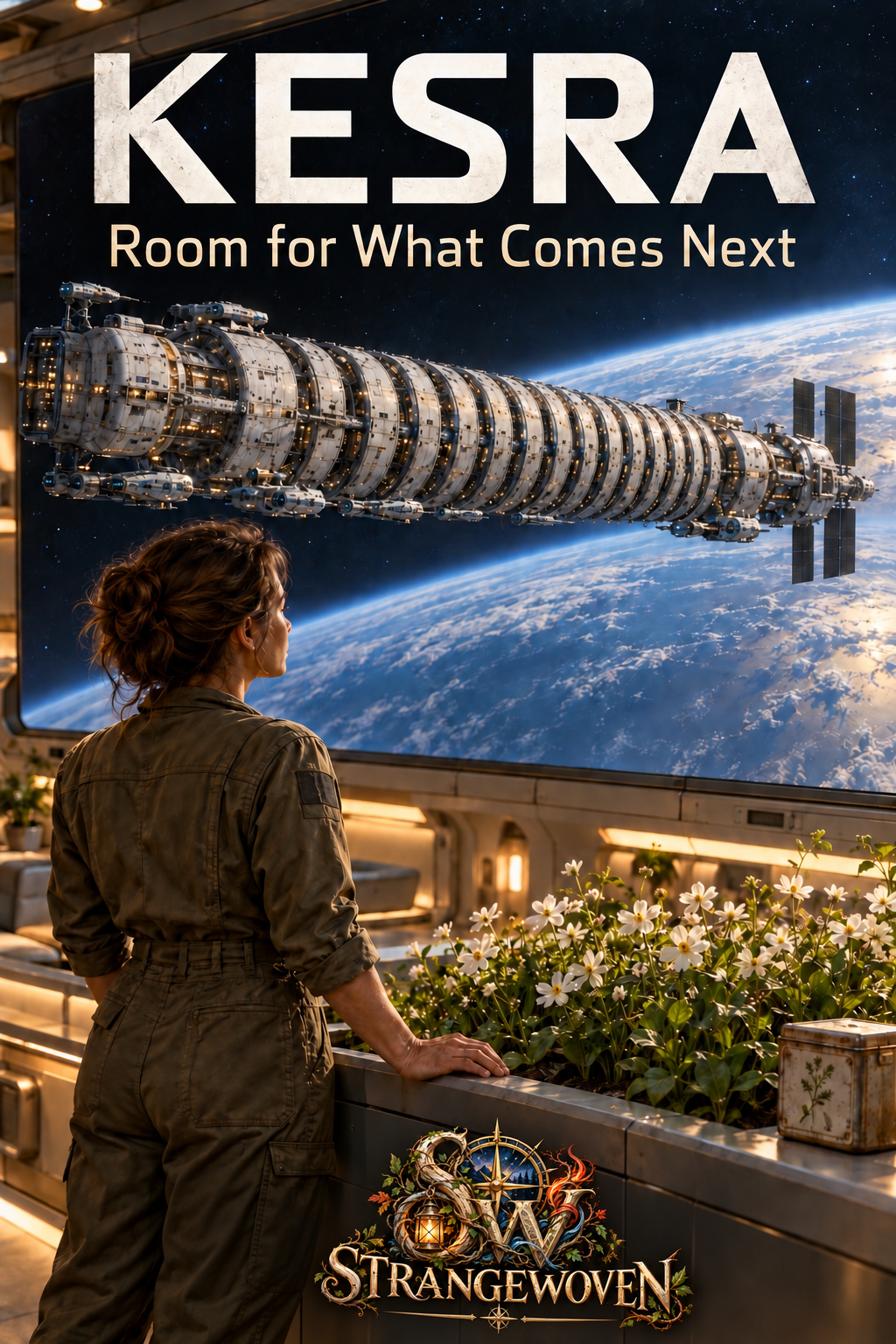
The Kesra had been turning for longer than Mara had been alive.
Its oldest rings carried replacement panels over replacement panels. Behind a cupboard in the crew galley, someone had painted a landscape with three suns. Nobody aboard knew who had painted it. Nobody moved the cupboard, either; the corner of sky visible above it had become part of breakfast.
Mara began her watch in the chime chamber.
She rested two fingers on a ceramic resonator beside the bench. A faint vibration traveled through the clay.
The people who had built the chamber were living elsewhere now. Their gardens had survived the voyage. Their children had grown. Once a year, a message arrived asking whether the crew had remembered to check the suspension cords.
Mara had checked them yesterday.
Her wrist unit sounded.
“Captain,” Oru said. “Surface control has revised the final boarding report.”
Mara stood.
“How revised?”
“Enough that you should come.”
On the bridge, Tavi occupied the flight station, six limbs resting against its controls and supports. Behind the reinforced window of a pressure enclosure, Oru’s sensory fringe shifted in the circulating liquid.
The main display showed the planet below.
Across its northern continent, a brown storm front covered roads the rescue teams had used that morning.
The evacuation had begun months earlier. Failed growing seasons had become food shortages; food shortages had become migration. By the time the Kesra reached the system, several settlements had already emptied.
Two other rescue vessels were working the southern hemisphere. A fourth was still weeks away.
Mara stopped beside the planning table.
Their own passenger habitats were nearly full. Several local vessels occupied the fixed docking berths, carrying families in cabins built for much shorter journeys.
A surface map opened.
Oru indicated a shelter east of the last boarding terminal.
“Three hundred and twelve people. They were listed under a different district. Both districts believed the other had transported them.”
Mara looked at the storm prediction.
“How long?”
“Surface control expects the road to become impassable within the hour.”
“Tavi?”
The pilot adjusted the display.
“The last carrier is boarding. I can hold its departure.”
“Can it reach the shelter?”
“No. The landing ground there won’t take it.”
Mara called surface operations.
“Find everything nearby that can carry passengers. Trucks, maintenance vehicles, agricultural haulers. Ask the shelter what they have running.”
Dorr’s voice came through next, accompanied by the quiet clatter of tools.
“Before you promise them accommodation, Captain, tell me where you intend to put them.”
Mara enlarged the habitat chart.
That was the question.
Sere arrived in a mobile humid enclosure, their folded fronds brushing its inner supports.
“Pod forty-three, section four,” they said through the translator. “The gathering hall can provide sleeping space.”
“For three hundred?”
“Sleeping space, yes. Comfortable living, no.”
“And life support?”
“Within limits, if the local transport beside us continues supporting its own passengers. We will need more stored food.”
“Food is coming up on the last freight load.”
“Then let us make sure it actually does.”
Vesh joined the conversation from medical.
A pale strand moved through their transparent membrane as the mobile frame settled beside the table.
“My staff can move the noncritical patients out of the adjoining clinic ward. Some will prefer staying with their families.”
“How many beds does that release?”
“Thirty-six. I will ask, not assign.”
Mara nodded and called the passenger council for ring forty-three.
A tired man appeared on the display. Behind him, volunteers were sorting bundles of bedding.
She explained the missing shelter group.
He listened without interrupting.
Then he turned away from the camera.
“We need the hall cleared,” he told someone. “And ask the kitchens to keep serving.”
He looked back.
“How many children?”
“We don’t have that breakdown yet.”
“Send it when you do. We’ll work out which families can share rooms.”
The call ended.
Dorr’s tools went quiet.
“There is another problem,” they said.
“Of course there is.”
“The carrier has reached its ascent mass limit.”
Mara stared at the cargo manifest.
Passengers. Water. Medical supplies. Food. Tools. Personal baggage.
Every line belonged to somebody.
At the surface terminal, rain struck the boarding tunnels hard enough to drown out conversation.
The shelter convoy arrived in whatever had been available: work trucks, two buses, a road grader towing a covered trailer.
Carrier crews met them under the terminal roof.
A woman climbed down from the first truck carrying a child and a canvas bag. Behind her, an older man refused to release the handles of a wheeled wooden case.
The loading supervisor sent Mara a picture.
“What’s in it?” she asked.
“Seeds. Agricultural samples. Paper records.”
“Keep it.”
“We still have to lose mass.”
“I know.”
Mara reviewed the freight list again.
The carrier had brought surface-handling equipment for unloading and supporting the habitat pod. Some of it was still secured aboard for the return.
She called Dorr.
“Can we leave the empty cargo frames and the spare boarding supports?”
A pause.
Then a dry clicking sound: Dorr’s plates shifting as they considered the loads.
“We will need replacements.”
“Can we make replacements?”
“Yes.”
“Can we replace the seeds?”
Another pause.
“No.”
The loading supervisor received a new list.
Cargo frames came off. Spare supports followed. Surface crews removed a heavy towing assembly that would not be needed in orbit.
Dorr checked the final figures.
“It fits,” they said. “With less margin than I like.”
“You’ve never liked a margin.”
“I have liked several. You used them.”
Mara smiled despite herself.
Then she watched the boarding count.
Two hundred and eighty-seven.
Two hundred and ninety-eight.
Three hundred and eleven.
The last passenger was a terminal worker who had stayed to check the shelter vehicles.
Three hundred and twelve.
The supervisor closed the manifest.
“All aboard.”
The carrier returned with mud dried along its lower frame.
Tavi brought it toward the stopped receiving ring while docking crews worked the alignment controls. Passengers waited inside the sealed habitat. Their bags were secured. Their children were strapped into temporary seats.
On the bridge display, the module moved slowly into its attachment position.
One restraint closed.
Then another.
Dorr watched the structural readings.
“Keep holding,” they said.
Nobody spoke.
The final locks engaged. Utility connections followed, each checked before the next was opened.
Sere’s staff began transferring environmental control from the carrier to the ship.
“Atmosphere stable.”
“Water circuit stable.”
“Pressure boundaries confirmed.”
The carrier released its load.
The Kesra had taken it.
Later, Mara visited ring forty-three.
The rotation had been brought up gradually. People were walking cautiously, learning how their bodies felt in the new gravity.
The gathering hall smelled of warm food and damp coats.
Volunteers had made narrow paths between sleeping spaces. Someone was repairing a torn bag. Two children sat under a table, arguing over which of them had seen the carrier engines first.
The older man from the terminal stood beside his wooden case.
“You kept this,” he said when Mara approached.
“Your loading supervisor made sure it stayed aboard.”
He opened the lid.
Inside were sealed seed containers, notebooks, and neatly labeled packets.
“My daughter started collecting these when the first harvest failed,” he said. “She thought we might need to grow somewhere else.”
“Is she aboard?”
He pointed toward the kitchen.
A woman was helping serve supper, one hand on a child’s shoulder.
Mara let out a breath she had not realized she was holding.
The man lifted a small packet from the case.
“These grow beside our doors. Nothing useful. Little white flowers.”
He looked around the crowded hall.
“Is there somewhere we could plant them?”
“I’ll ask Sere.”
The journey to their new settlement lasted long enough for strangers to become neighbors.
The crew repaired pumps and settled arguments over water schedules. Passenger engineers joined maintenance shifts. Teachers reopened classes. The kitchens learned which foods could be shared and which needed separate preparation.
Mara slept badly for a week, then better.
When the passengers finally disembarked, the gathering hall emptied in stages.
Blankets disappeared. Names were removed from cabin doors. People returned borrowed tools and discovered belongings they had been certain were lost.
The little white flowers stayed.
Their growers had planted another bed beside their new homes. They asked the crew to keep the first one.
A small care card was fastened beside it.
Sere studied the instructions.
“They have underestimated the watering interval,” their translator said.
“Will you tell them?”
“After they have finished moving.”
Mara sat beside the planter. Down the passage, maintenance teams were preparing the empty spaces for whoever came next.
Her wrist unit sounded.
Oru had a message from regional dispatch.
Another world needed assistance. The journey would take months. The warning had come early enough to begin.
Mara looked once more at the flowers.
Then she stood and went to the bridge.

